

Closed & Restricted Networks
Metering that never calls home.
Open iT installs as a self-contained deployment inside a closed area. Collection, reporting and analysis all run within the boundary, so nothing has to cross it for the system to work.
- Level 1, Level 2, CLIMS and reporting, all inside the enclave
- Data leaves anonymized, on your terms, or not at all
- Connected subnets roll up. Closed areas stay closed.
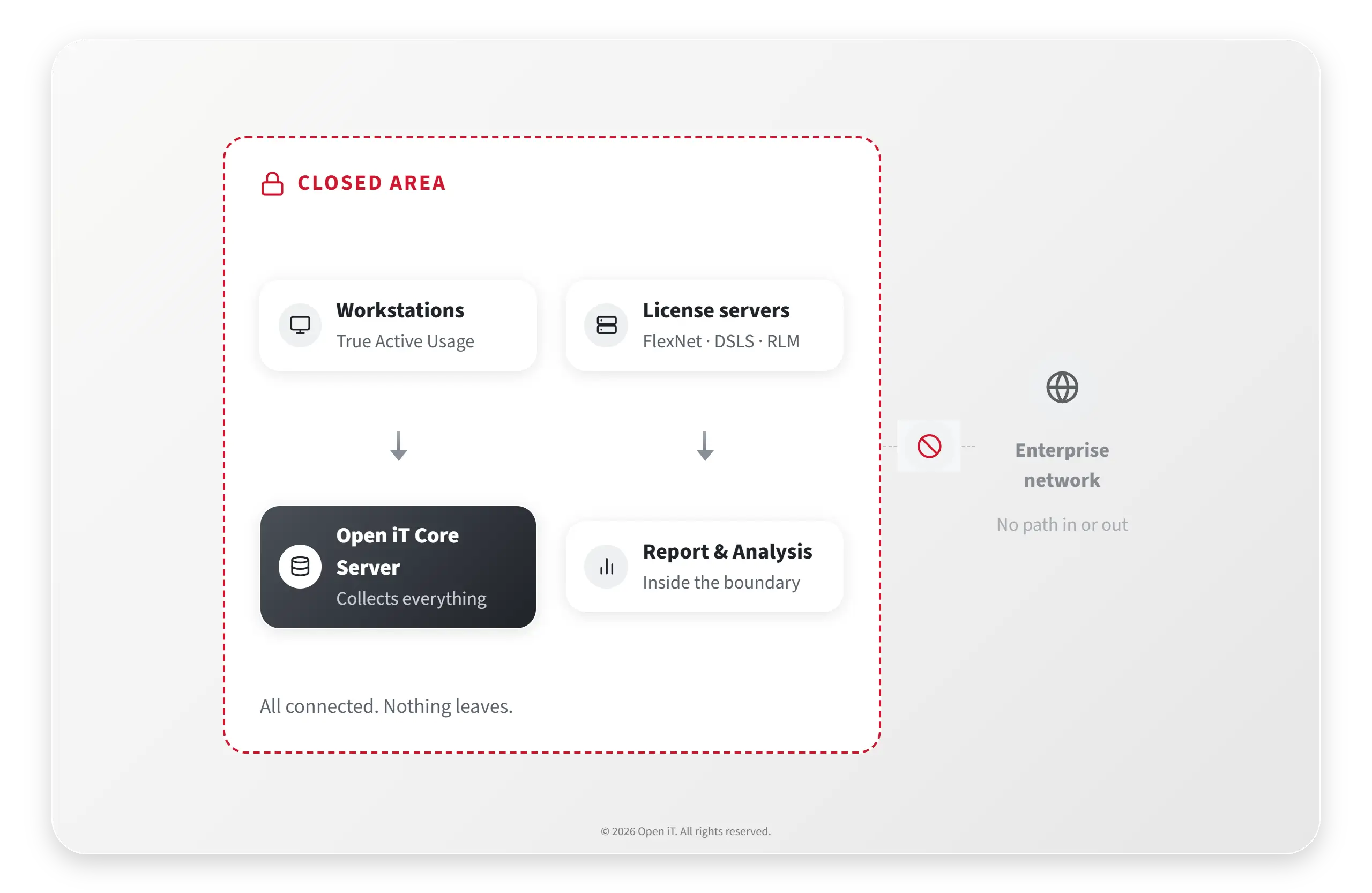
Your closed areas hold the most expensive engineering software you own and the least data about it.
A tool that meters inside the enclave and analyzes in a cloud service isn’t an air-gapped tool. That surfaces three weeks in, after the architecture review, and it ends the evaluation. So the open side of the estate gets optimized every renewal while the closed side runs on a seat count nobody has tested against usage.
Across engineering estates, 20 to 40 percent of licenses are idle at any given moment. In a closed area that number isn’t a measurement. It’s an assumption, and it has been renewed on for years.
Was Open iT leistet
1
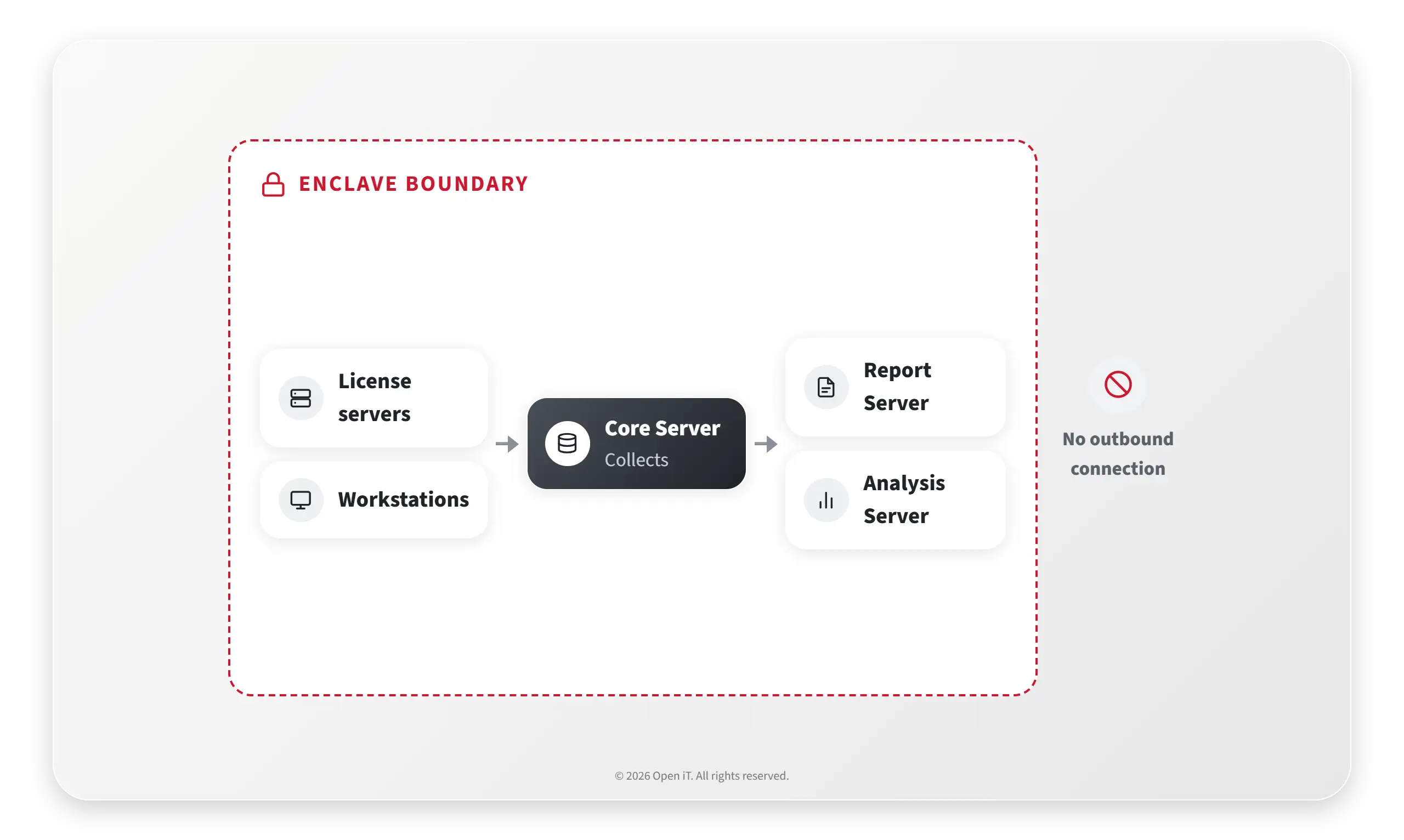
Run the whole stack inside the boundary.
Four things install in the area and talk only to each other: Level 1 against the license managers, Level 2 on the workstations for True Active Usage, CLIMS as the one console for every server in there, and the reporting and analysis servers behind them. Nothing calls out. Nothing has to cross the boundary for any of it to work.
2
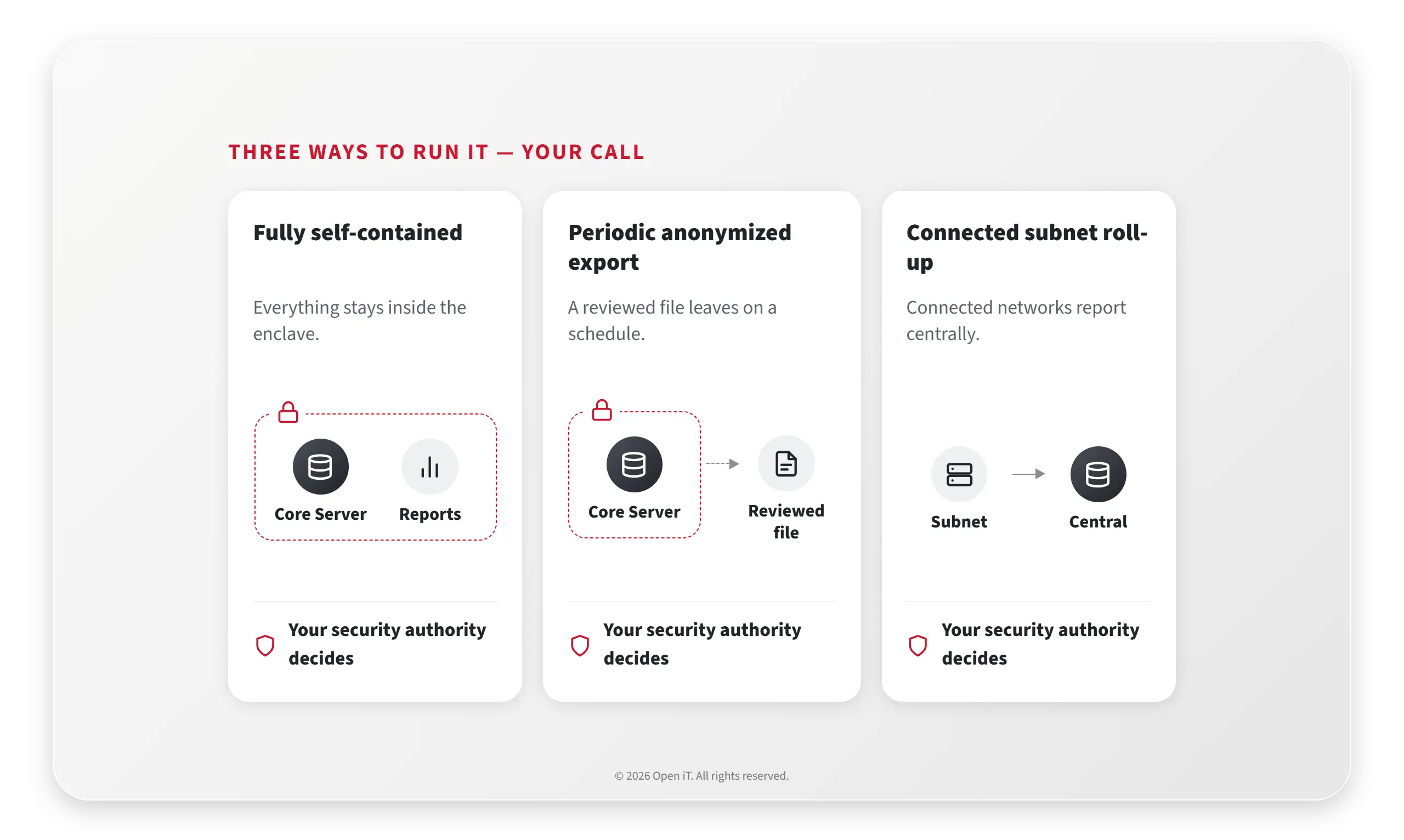
Move data on your terms, or not at all.
Three patterns cover most sites. Fully self-contained, where the area reports from inside itself and nothing leaves. Periodic export, where an anonymized data set goes out for consolidated reporting on the open side. Or a connected roll-up, where a path already exists between an enterprise network and a program subnetwork and collected data is forwarded to a central server. Which one you get is a security-governance decision your team makes during implementation planning, not a product setting.
3
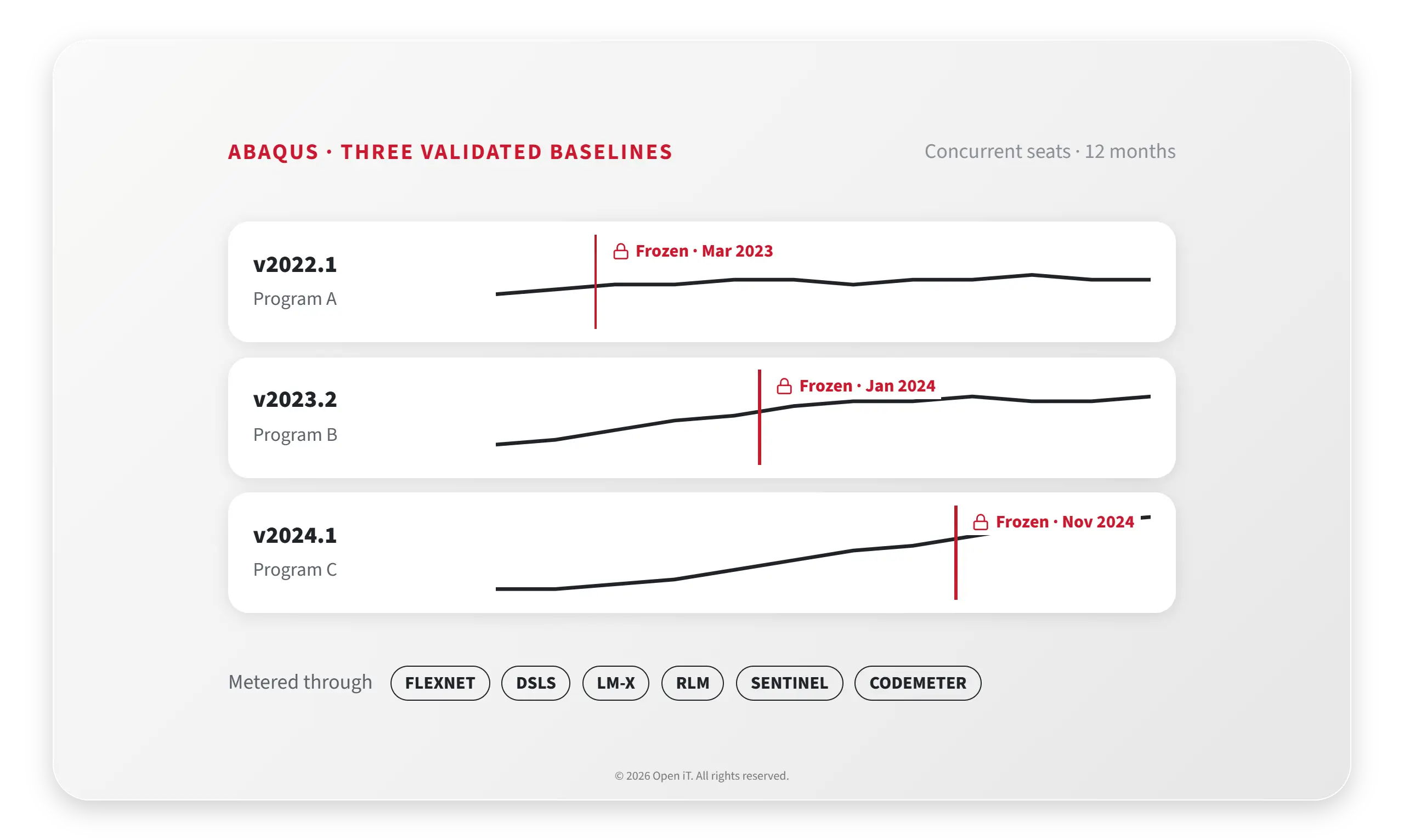
Meter a frozen baseline without unfreezing it.
Metering follows the license manager rather than an application build, so FlexNet, DSLS, LM-X, RLM, Sentinel and CodeMeter estates are covered whatever release sits behind them. Version data is captured in the record, so three programs on three validated baselines of the same tool read as three demand curves. Earlier Open iT releases keep receiving maintenance too: hotfix streams are maintained for 9.17, 9.19 and 10.1 across Core Server, client and CLIMS.
4
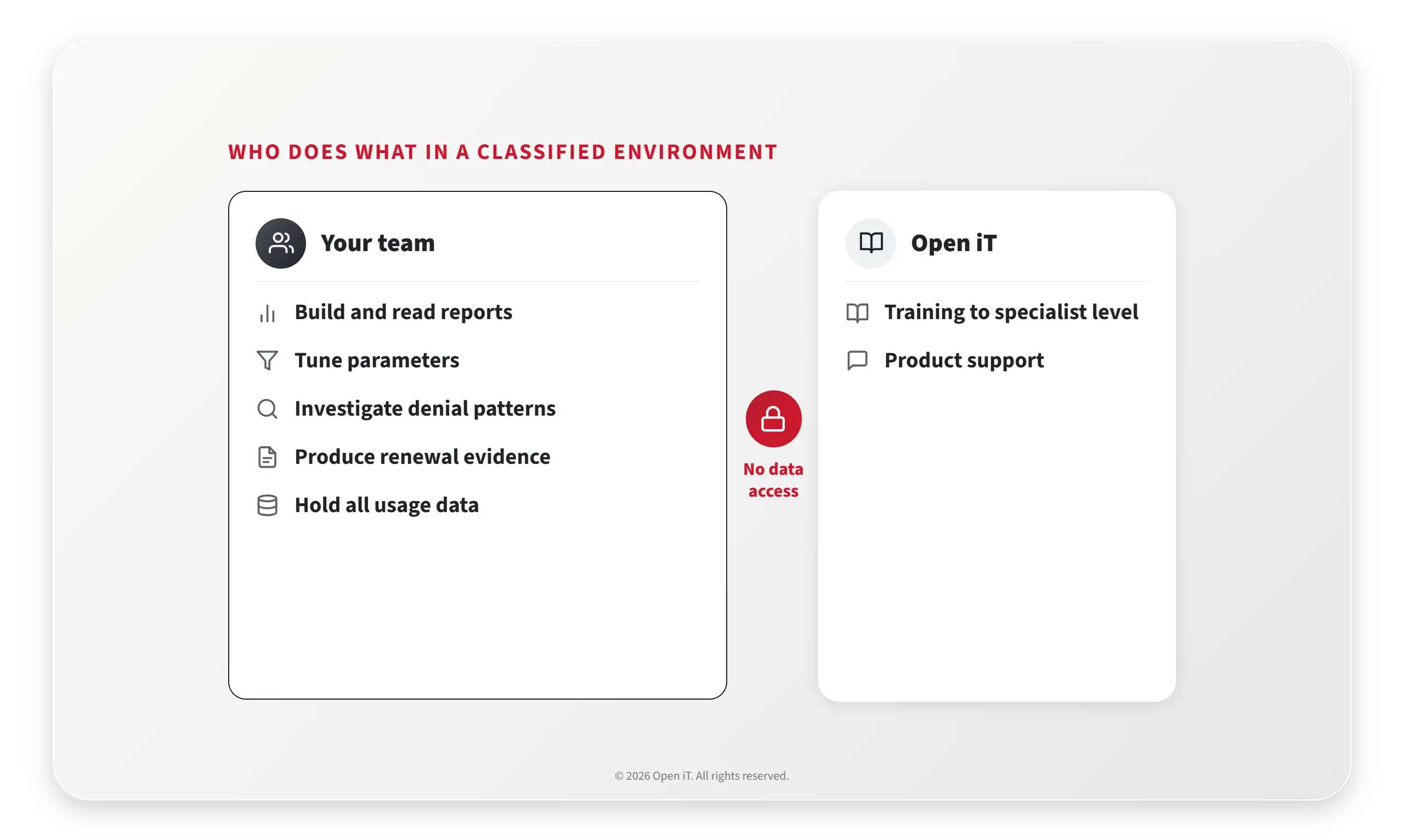
Train your people, because we're not allowed to see your data.
In a classified environment we can’t look at your data, which rules out the model where the vendor runs the analysis and hands over a report. So your team is trained to data analysis specialist level, on your system, with your data. They build and interpret the reports, tune parameters, investigate a denial pattern and produce the evidence a renewal needs, without anyone outside the organization seeing a record.
Haben Sie Fragen? Wenden Sie sich an einen Lizenzspezialisten.
Closed-Area Deployment Checklist
What your security team needs to decide before an implementation plan can be written. Record what is settled, flag what is not, and bring the result to the scoping conversation. Your answers stay in this browser tab until you choose to send them.
decisions made
Your decision record
Decided items are the inputs to an implementation plan. Open items are the agenda for the scoping conversation. Bring us the constraint, not the requirement.
Wie dies berechnet wird
Jede Zeile ist eine arithmetische Berechnung auf der Grundlage Ihrer Eingaben und zweier veröffentlichter Kundenergebnisse. Hier wird nichts modelliert, gewichtet oder abgeleitet.
- Jährliche Ausgaben = Anzahl der Plätze × Kosten pro Platz.
- Ungenutzte Kapazität = Sitzplätze × Ungenutzungsanteil. Der Standardbereich von 20 bis 40 Prozent entspricht den Werten, die Open iT in technischen Einrichtungen ermittelt hat.
- Veröffentlichter Richtwert = jährliche Ausgaben × 20 % bzw. × 20,8 %. Devon Energy hat sein Budget für Subsurface-Software bei 11 Anbietern und Modulen um 20 % gekürzt (openit.com, 2022). Ein veröffentlichter, anonymisierter Energiekonzern der Supermajor-Klasse reduzierte seine Ausgaben für Subsurface-Modellierung von 12 Mio. US-Dollar auf 9,5 Mio. US-Dollar, was einem Rückgang von 20,8 % entspricht. Beide Fälle werden als Ergebnisse von Einsparungs- und Optimierungsmaßnahmen ausgewiesen.
- Obergrenze für die gleichzeitige Nutzerzahl = Sitzplätze × (1 minus Leerlaufanteil). Die tatsächliche Spitzenauslastung liegt über der durchschnittlichen Nachfrage und kann nur durch eine Zugangsbeschränkung erreicht werden.
Die ungenutzte Kapazität ist die Obergrenze: jede zurückgewonnene Leerlaufstunde, was kein Anwesen schafft. Der Referenzwert ist die Untergrenze, auf der zwei tatsächliche Implementierungen gelandet sind, die nur einen Punkt voneinander entfernt liegen. Ihr Ergebnis liegt dazwischen, und der einzige Weg, die Spanne zu verringern, ist die Messung.
Was Ihnen das nicht verraten kann
- Ihr tatsächlicher Leerlaufanteil. Solange Level 2 die Host-Aktivität noch nicht misst, handelt es sich bei dem Schieberegler um eine Annahme, und das gesamte Ergebnis hängt von diesem Eingabewert ab.
- Ihre tatsächliche Spitzenauslastung. Anhand der Messdaten aus zwölf Monaten lässt sich die Spitzenauslastung im Vergleich zur zulässigen Kapazität pro Modul ermitteln.
- Welche Lizenzen können zurückgewonnen werden? Die automatische Rückgewinnung läuft auf FlexLM, LM-X, LUM und RLM. Petrel auf FlexNet ist dafür geeignet; alle anderen Komponenten in Ihrer Infrastruktur müssen zunächst überprüft werden.
- Ob „Suspend“ für Ihre Betriebsabläufe geeignet ist. Die Wiederinbetriebnahme von Petrel dauert für einen Techniker 5 bis 15 Minuten, weshalb „Suspend“ besser ist als „Terminate“; die Schwellenwerte müssen jedoch weiterhin gemeinsam mit Ihren Vorgesetzten festgelegt werden.
Angaben in US-Dollar. Als Referenzspanne dienen zwei veröffentlichte Kundenergebnisse. Dabei handelt es sich um die Ergebnisse dieses Kunden, die als Ertrags- und Optimierungsergebnisse ausgewiesen sind, und nicht um eine Prognose für Ihren Immobilienbestand.
Häufig gestellte Fragen
Does Open iT need internet access to work?
No. Every component runs inside the deployment, analysis included. A closed area gets metering, denial reporting and active-versus-inactive analysis on the same terms as your open network, with no connection to anything outside it.
Can we consolidate closed and open reporting?
Only if your security governance allows it. Where a path already exists, collected data is forwarded to a central server. Where it doesn’t, the area reports from inside itself, and anything that does leave is a periodic anonymized export your security team specified.
Can you support us with cleared personnel?
Bring the requirement to the scoping conversation. Where a program needs support staff of a particular nationality or holding a particular clearance, that gets agreed as part of the engagement rather than discovered afterwards.
Do we have to upgrade to stay supported?
No. Earlier releases keep receiving maintenance, with hotfix streams for 9.17, 9.19 and 10.1 across Core Server, client and CLIMS. Accredited environments can’t upgrade on a vendor’s schedule and shouldn’t be asked to.
Bring us the constraint, not the requirement. Which areas are closed, which baselines are frozen, what your personnel rules are, and which applications matter. Then start with a Level 1 usage assessment across one renewal cycle. In a closed area it runs entirely inside the boundary.