

Closed & Restricted Networks
Metering that never calls home.
Open iT installs as a self-contained deployment inside a closed area. Collection, reporting and analysis all run within the boundary, so nothing has to cross it for the system to work.
- Level 1, Level 2, CLIMS and reporting, all inside the enclave
- Data leaves anonymized, on your terms, or not at all
- Connected subnets roll up. Closed areas stay closed.
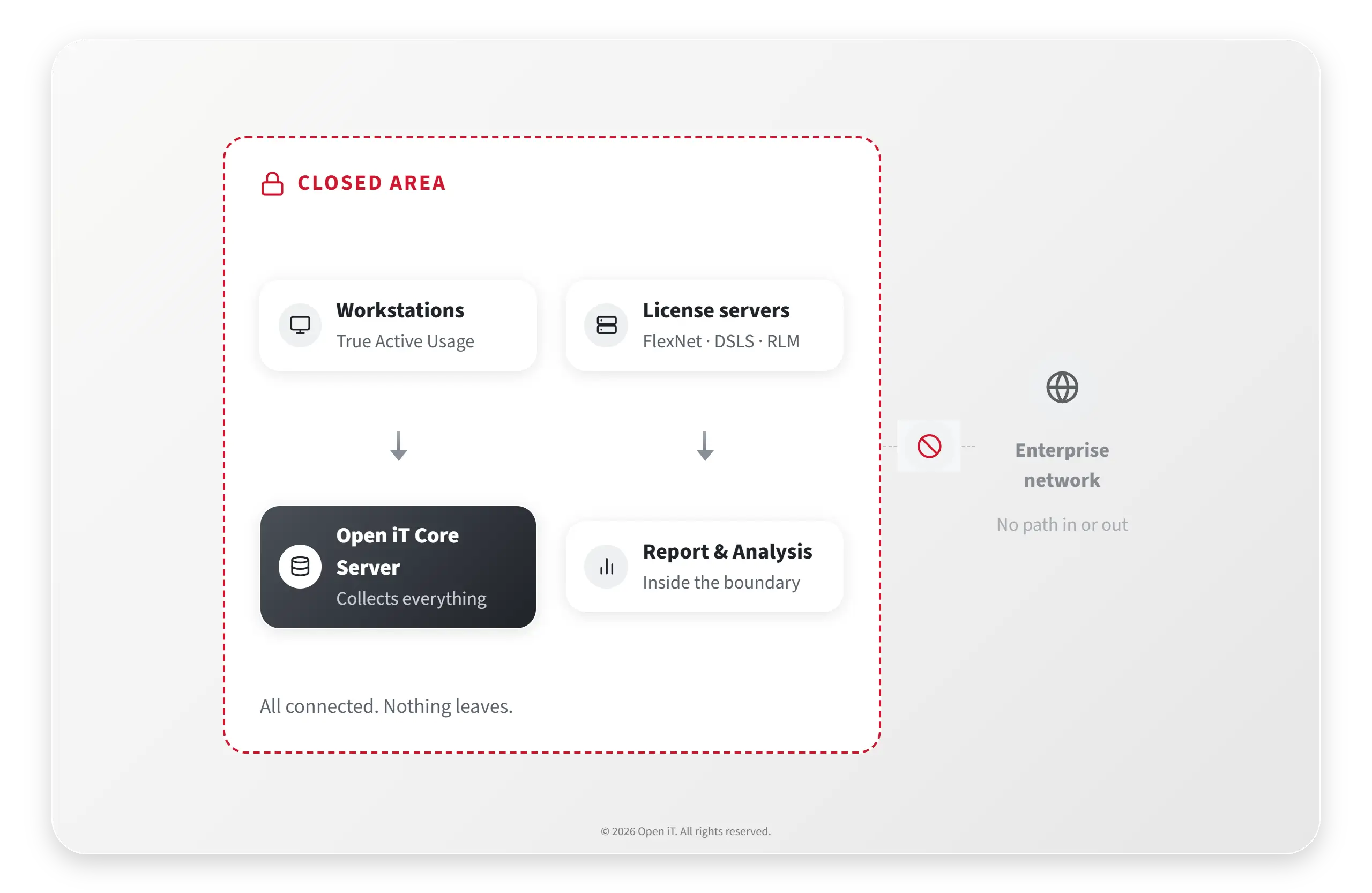
Your closed areas hold the most expensive engineering software you own and the least data about it.
A tool that meters inside the enclave and analyzes in a cloud service isn’t an air-gapped tool. That surfaces three weeks in, after the architecture review, and it ends the evaluation. So the open side of the estate gets optimized every renewal while the closed side runs on a seat count nobody has tested against usage.
Across engineering estates, 20 to 40 percent of licenses are idle at any given moment. In a closed area that number isn’t a measurement. It’s an assumption, and it has been renewed on for years.
Fonctionnalités d'Open iT
1
Run the whole stack inside the boundary.
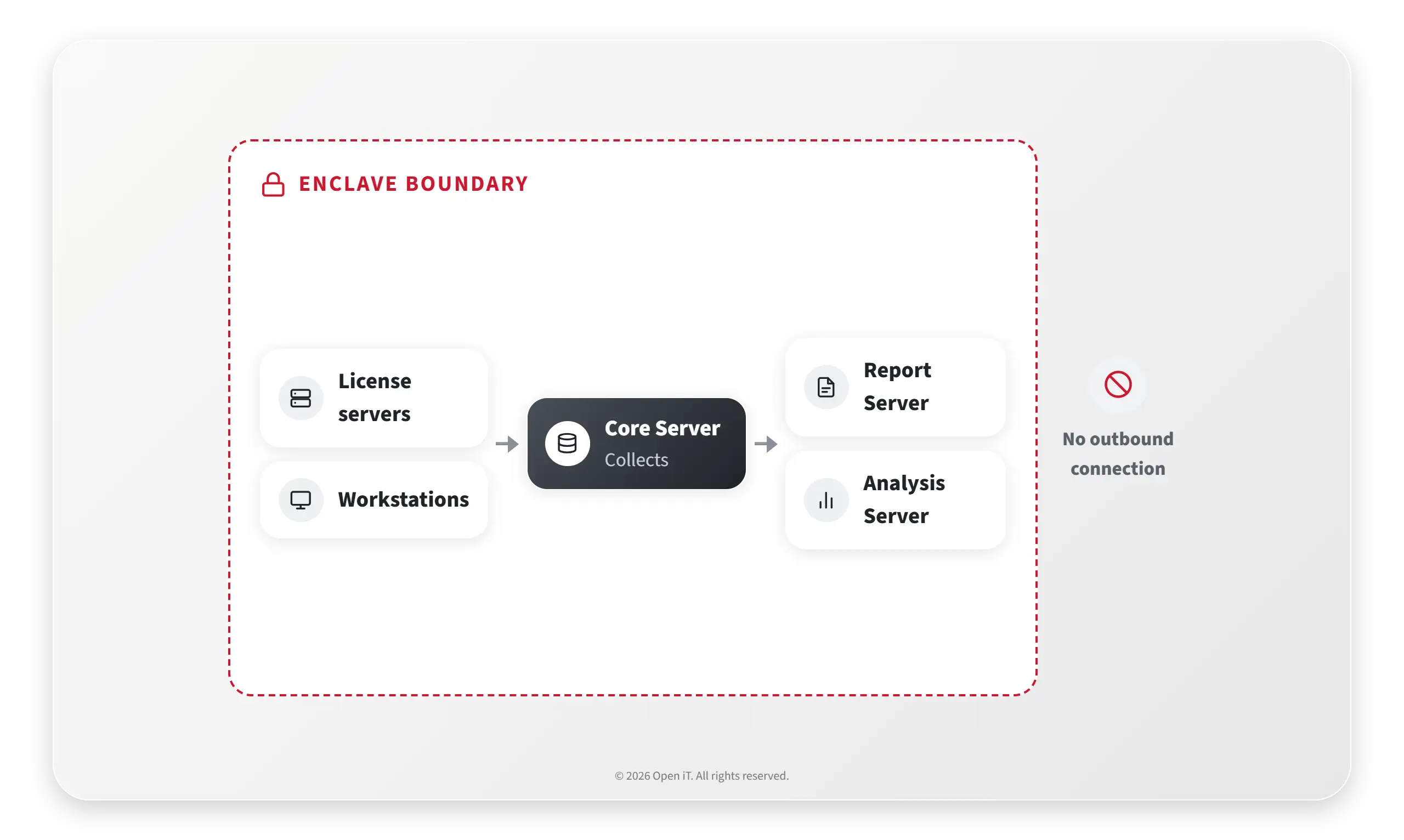
Four things install in the area and talk only to each other: Level 1 against the license managers, Level 2 on the workstations for True Active Usage, CLIMS as the one console for every server in there, and the reporting and analysis servers behind them. Nothing calls out. Nothing has to cross the boundary for any of it to work.
2
Move data on your terms, or not at all.
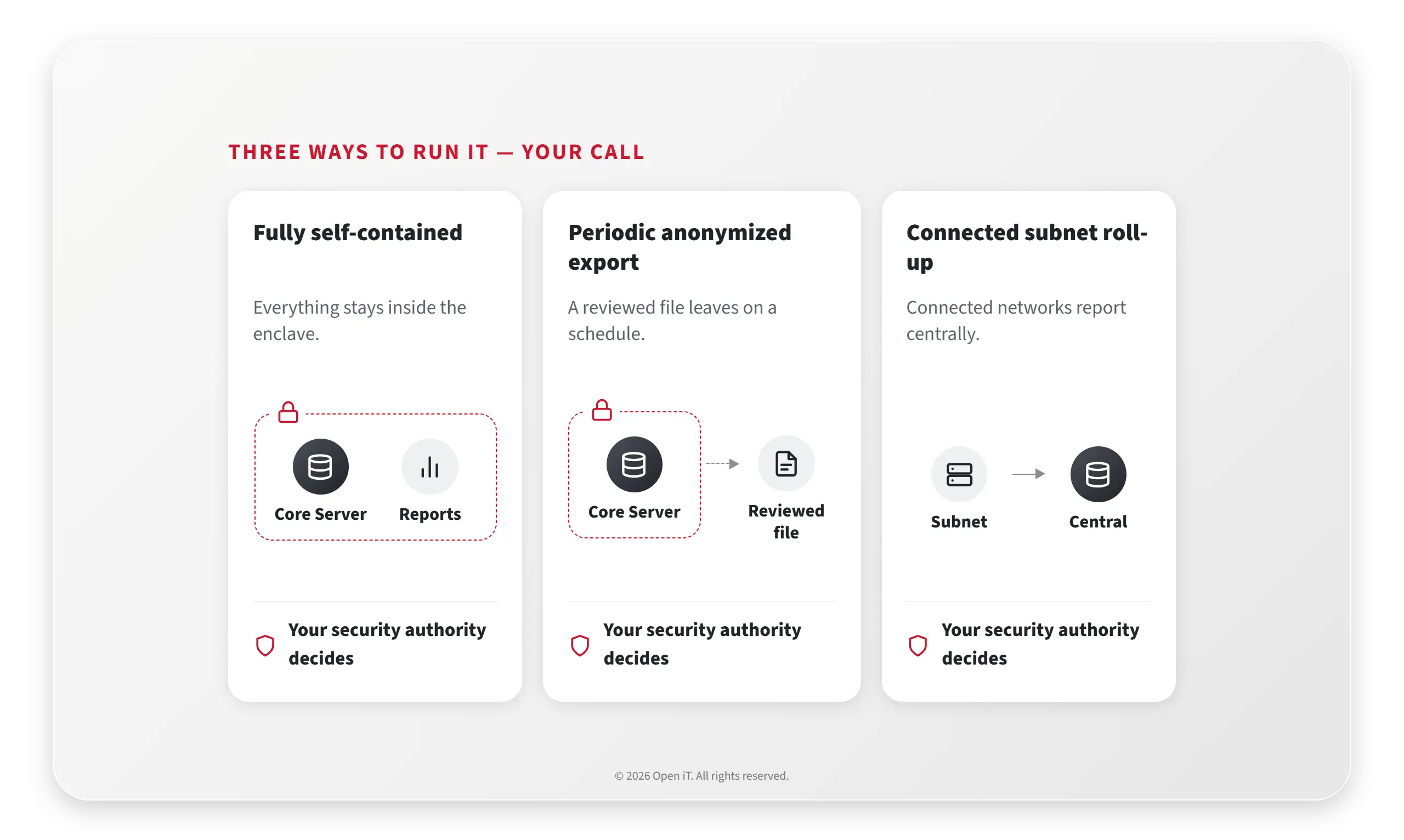
Three patterns cover most sites. Fully self-contained, where the area reports from inside itself and nothing leaves. Periodic export, where an anonymized data set goes out for consolidated reporting on the open side. Or a connected roll-up, where a path already exists between an enterprise network and a program subnetwork and collected data is forwarded to a central server. Which one you get is a security-governance decision your team makes during implementation planning, not a product setting.
3
Meter a frozen baseline without unfreezing it.
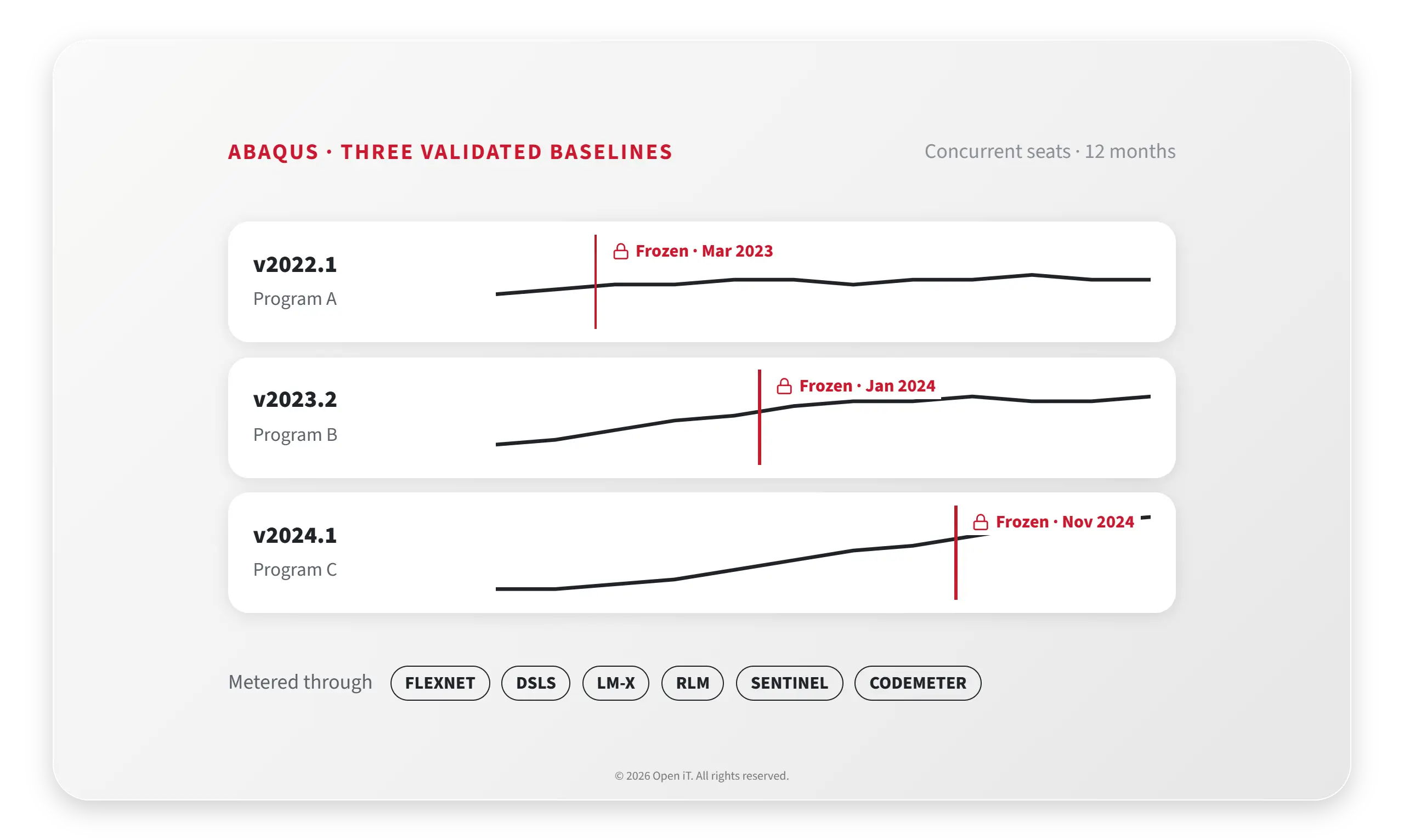
Metering follows the license manager rather than an application build, so FlexNet, DSLS, LM-X, RLM, Sentinel and CodeMeter estates are covered whatever release sits behind them. Version data is captured in the record, so three programs on three validated baselines of the same tool read as three demand curves. Earlier Open iT releases keep receiving maintenance too: hotfix streams are maintained for 9.17, 9.19 and 10.1 across Core Server, client and CLIMS.
4
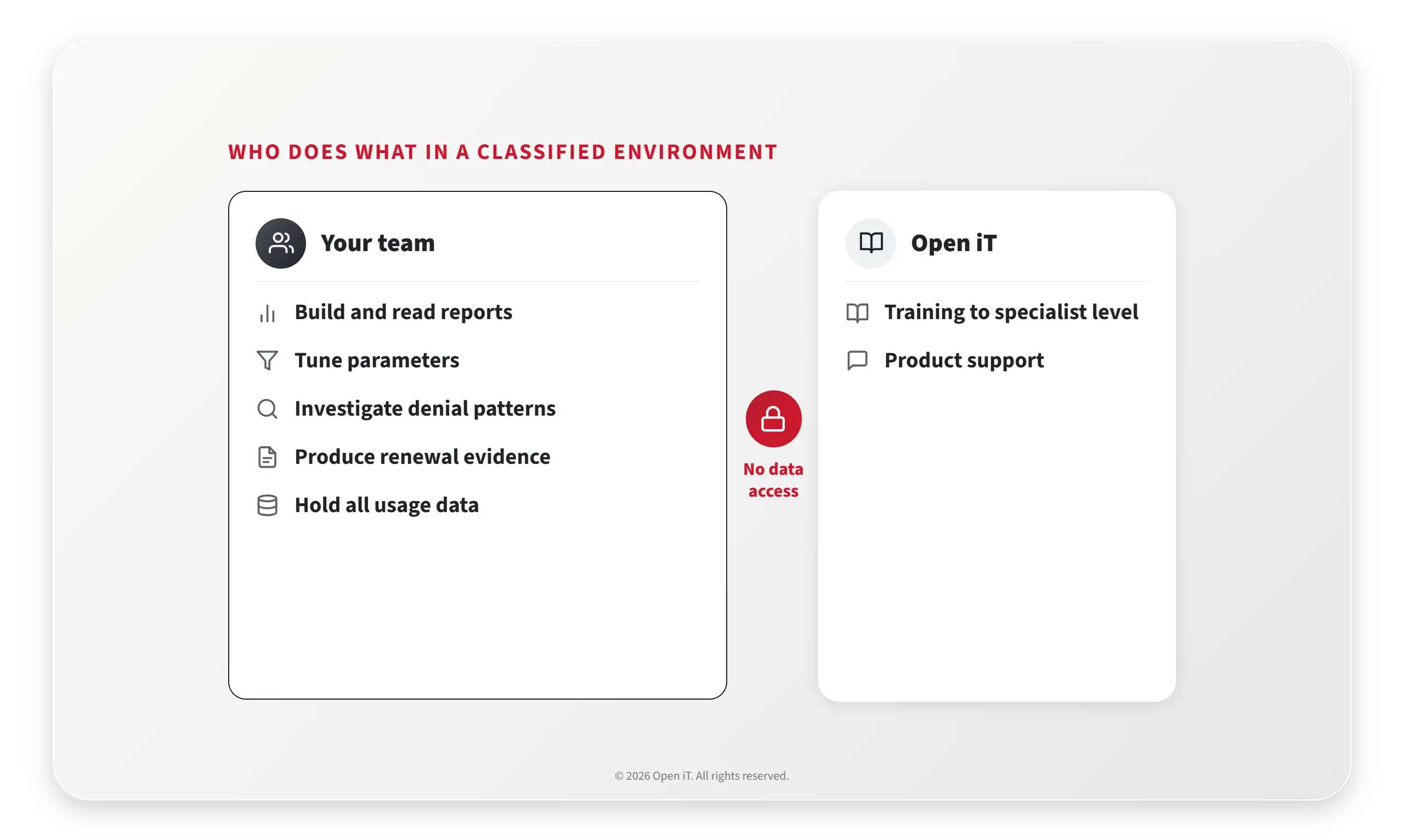
Train your people, because we're not allowed to see your data.
In a classified environment we can’t look at your data, which rules out the model where the vendor runs the analysis and hands over a report. So your team is trained to data analysis specialist level, on your system, with your data. They build and interpret the reports, tune parameters, investigate a denial pattern and produce the evidence a renewal needs, without anyone outside the organization seeing a record.
Vous avez des questions ? Contactez un spécialiste des licences.
Closed-Area Deployment Checklist
What your security team needs to decide before an implementation plan can be written. Record what is settled, flag what is not, and bring the result to the scoping conversation. Your answers stay in this browser tab until you choose to send them.
decisions made
Your decision record
Decided items are the inputs to an implementation plan. Open items are the agenda for the scoping conversation. Bring us the constraint, not the requirement.
Comment ce chiffre est-il calculé ?
Chaque ligne correspond à un calcul arithmétique portant sur vos données d'entrée et sur deux résultats publiés par des clients. Aucune modélisation, pondération ou déduction n'est effectuée ici.
- Dépenses annuelles = nombre de places × coût par place.
- Capacité inutilisée = nombre de places × taux d'inutilisation. La fourchette par défaut de 20 à 40 % correspond aux mesures effectuées par Open iT dans les parcs d'équipements d'ingénierie.
- Référence publiée = dépenses annuelles × 20 % et × 20,8 %. Devon Energy a réduit de 20 % son budget consacré aux logiciels de gestion du sous-sol, réparti entre 11 fournisseurs et modules (openit.com, 2022). Un géant mondial de l’énergie, dont l’identité a été anonymisée, a réduit son budget consacré à la modélisation du sous-sol de 12 millions de dollars à 9,5 millions de dollars, soit une baisse de 20,8 %. Ces deux exemples sont présentés comme des résultats en matière de rationalisation et d’optimisation.
- Plafond de concurrence = nombre de places × (1 moins le taux d'inactivité). La concurrence maximale réelle est supérieure à la demande moyenne et ne peut résulter que de la régulation du débit.
La capacité inutilisée représente le plafond : chaque heure d'inactivité récupérée, ce qu'aucun domaine ne parvient à atteindre. La référence correspond au seuil minimal atteint par deux déploiements concrets, dont les résultats ne s'écartent que d'un point l'un de l'autre. Votre résultat se situe entre ces deux valeurs, et la seule façon de le préciser est de le mesurer.
Ce que cela ne peut pas vous dire
- Votre pourcentage réel d'inactivité. Tant que le niveau 2 ne mesure pas l'activité de l'hôte, la valeur du curseur n'est qu'une estimation, et c'est sur cette valeur que repose l'ensemble du résultat.
- Votre nombre réel d'utilisateurs simultanés en pic. Douze mois de relevés vous permettent de déterminer le pic par rapport au quota alloué à chaque module.
- Quels sont les sièges récupérables ? La récupération automatique s'applique à FlexLM, LM-X, LUM et RLM. Petrel sur FlexNet est éligible ; pour tout autre élément de votre parc, une vérification préalable est nécessaire.
- Déterminez si la mise en attente est adaptée à vos opérations. La réactivation de Petrel prend entre 5 et 15 minutes à un ingénieur ; c’est pourquoi la mise en attente est préférable à l’arrêt définitif, mais les seuils doivent tout de même être définis avec vos responsables.
Chiffres en dollars américains. Deux résultats clients publiés servent de fourchette de référence. Il s'agit des résultats de ces clients, présentés sous forme de résultats en matière de rentabilisation et d'optimisation, et ne constituent pas une projection pour votre parc immobilier.
Questions fréquemment posées
Does Open iT need internet access to work?
No. Every component runs inside the deployment, analysis included. A closed area gets metering, denial reporting and active-versus-inactive analysis on the same terms as your open network, with no connection to anything outside it.
Can we consolidate closed and open reporting?
Only if your security governance allows it. Where a path already exists, collected data is forwarded to a central server. Where it doesn’t, the area reports from inside itself, and anything that does leave is a periodic anonymized export your security team specified.
Can you support us with cleared personnel?
Bring the requirement to the scoping conversation. Where a program needs support staff of a particular nationality or holding a particular clearance, that gets agreed as part of the engagement rather than discovered afterwards.
Do we have to upgrade to stay supported?
No. Earlier releases keep receiving maintenance, with hotfix streams for 9.17, 9.19 and 10.1 across Core Server, client and CLIMS. Accredited environments can’t upgrade on a vendor’s schedule and shouldn’t be asked to.
Bring us the constraint, not the requirement. Which areas are closed, which baselines are frozen, what your personnel rules are, and which applications matter. Then start with a Level 1 usage assessment across one renewal cycle. In a closed area it runs entirely inside the boundary.