


- En este artículo se comparan cinco plataformas para la gestión de licencias de ingeniería y aplicaciones especializadas: Open iT, FlexNet Manager for Engineering Applications (Flexera), OpenLM, TeamEDA (LAMUM) y X-Formation License Statistics.
- La verdadera línea divisoria no son los datos de salida. Todas las plataformas aquí mencionadas disponen de ellos. Lo que importa es si una plataforma mide la actividad real de los dispositivos finales (teclado, ratón, CPU, E/S) para distinguir el uso activo de una sesión inactiva que se mantiene abierta.
- La cobertura de los gestores de licencias varía considerablemente dentro de esta categoría: desde unos pocos gestores principales hasta más de 90 publicados (Open iT) o más de 100 según sus propias declaraciones (OpenLM). Pregunta a cualquier proveedor cuál es su cobertura para tu entorno específico, en lugar de pedirle una cifra general.
- Las cinco ofrecen alguna versión de recuperación automática de licencias inactivas («harvesting»), pero los detalles varían. Open iT es la única de las aquí mencionadas que documenta métodos de acción con nombre específico (log, standby, suspend, terminate) y niveles de prioridad de las reglas.
Un martes por la tarde, en una organización de 5.000 personas, a tres ingenieros se les niega el acceso a Petrel, mientras que un informe de utilización de licencias insiste en que el fondo común está medio vacío; y dos plantas más arriba, una licencia de CATIA permanece abierta e inactiva porque nadie cerró la sesión antes del almuerzo. Ambos síntomas se remontan al mismo punto ciego: un manual de administración de licencias diseñado para puestos de usuario designado, recuentos de instalaciones y renovaciones gestionadas mediante hojas de cálculo, y no para los grupos flotantes a nivel de funciones en los que realmente se ejecutan las aplicaciones de ingeniería y especializadas.
Qué hay que tener en cuenta a la hora de elegir una solución de gestión de activos de software de ingeniería (ESAM)
La gestión de activos de software de ingeniería es un problema más específico y complejo que la gestión general de activos de software (SAM). Las aplicaciones se licencian por funciones en lugar de por producto (un único título comercial puede ocultar docenas de módulos con licencias independientes), y se ejecutan como grupos flotantes y concurrentes compartidos por todo un equipo, en lugar de estar asignadas a una persona concreta. Una «retirada» indica que una licencia ha salido del grupo, pero no dice nada sobre si dicha licencia estaba en uso. Hay cuatro aspectos que diferencian una plataforma diseñada específicamente para esto de un gestor de licencias de uso general integrado en ella:
Nivel de detalle de la medición. Los datos de sesión activa y de denegación, procedentes directamente del servidor de licencias, son imprescindibles. Todas las herramientas de esta categoría lo incluyen. La diferencia entre los distintos proveedores se aprecia un nivel más abajo: ¿mide la plataforma si una sesión «retirada» estaba realmente activa (teclado, ratón, CPU, E/S), o se limita a registrar que se ha «retirado»? Esa distinción es lo que separa el «necesitamos más licencias» del «tenemos que solucionar cómo se gestionan las que ya tenemos».
Amplitud del análisis. Informar sobre lo que ya ha ocurrido es lo mínimo que se espera. La cuestión más compleja es qué hace la plataforma con esos datos a continuación: ¿puede simular un acuerdo de licencia o un escenario hipotético antes de que se destine presupuesto al mismo, convertir un patrón de denegaciones en una posición negociadora en lugar de una mera cifra, y proyectar las necesidades futuras de licencias a partir del crecimiento o la expansión previstos y de las tendencias históricas de uso, en lugar de dejar esos cálculos en manos de una hoja de cálculo?
Entrega. La utilidad de una plataforma depende de lo que ocurra tras la orden de compra. Busca una puesta en marcha bien definida: un punto de contacto específico, una fase de integración técnica que no exija a tu equipo convertirse en expertos en la herramienta de la noche a la mañana, y una transferencia de conocimientos basada en funciones que comience durante la implementación, en lugar de dejarse para un portal de autoservicio. Los mejores proveedores de esta categoría consideran la puesta en marcha como el inicio de la relación, no como el final de la venta.
Asistencia técnica. Acceso continuo a personas que conocen el producto, no solo a una cola de incidencias: desarrollo de paneles de control e informes que no obligue a tu equipo a aprender a utilizar una herramienta de BI desde cero, y una forma estructurada de revisar los datos de uso antes de una renovación, en lugar de empezar ese análisis desde cero.
Cada perfil de plataforma que figura a continuación, incluidos los criterios mencionados anteriormente, se ha elaborado a partir de los datos de producto publicados por cada proveedor y de plataformas de reseñas independientes (Gartner Peer Insights, G2), y no solo a partir de los textos publicitarios. Teniendo en cuenta esos cuatro criterios, a continuación se presenta una comparación entre las cinco plataformas de esta categoría, empezando por la que se ha diseñado específicamente en torno a los cuatro.
Open iT
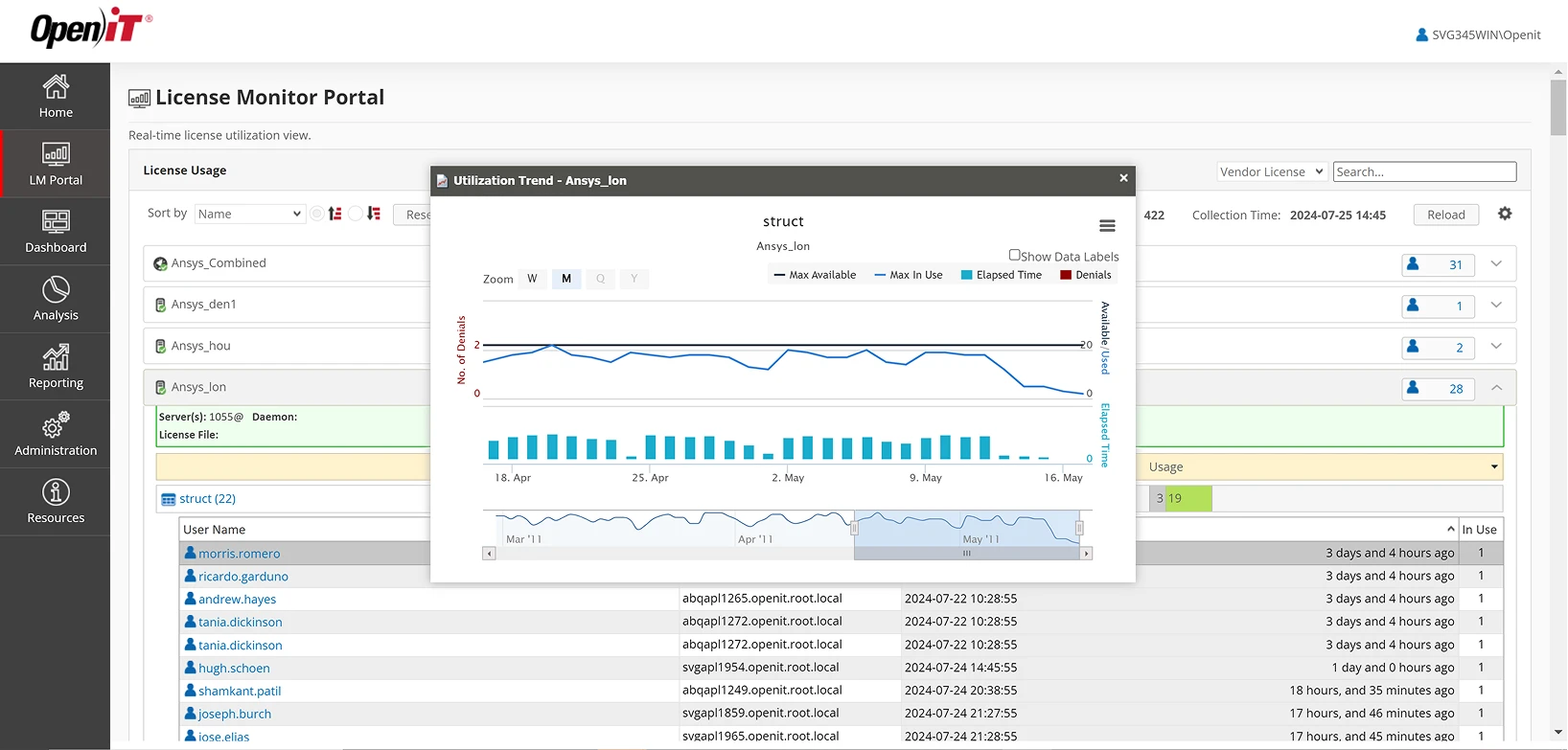
Open iT, a través deLicenseAnalyzer™y CLIMS™, estructura todo su producto en torno a la cuestión de la profundidad de la medición, denominando las capas «Nivel 1», «Nivel 2» y «Nivel 3».
Profundidad de la medición. El Nivel 1 lee los registros de salida, los rechazos y la concurrencia directamente de los registros del servidor de licencias, realizando sondeos cada hora con muestras de cinco minutos, e incluye informes de rechazos, informes de tiempo transcurrido y detección de licencias persistentes para las sesiones que permanecen abiertas una vez finalizado el trabajo. La correspondencia entre características y conjuntos de características, gestionada de forma centralizada, mantiene la precisión de la medición a nivel de módulo cuando un proveedor reorganiza un paquete, lo que subsana precisamente la laguna que impide una visión basada en «productos instalados» de software como Petrel o CATIA. El Nivel 2, «Uso activo real», es la capa que responde a la pregunta sobre el uso real: actividad del teclado, el ratón, la CPU y las E/S en el equipo host, correlacionada con la activación a través del informe de ratio de trabajo: la cifra que distingue entre una auténtica falta de capacidad y el hecho de que unas pocas personas mantengan abiertas las licencias. El nivel 3, la recuperación automatizada, actúa directamente sobre ese tiempo de inactividad mediante cuatro métodos de acción (registro, espera, suspensión y terminación) en cuatro niveles de prioridad de reglas, actualmente en FlexLM, LM-X, LUM y RLM. En el caso concreto de Petrel y ANSYS Workbench, una sesión recuperada se reabre en un plazo de entre cinco y quince minutos, lo que supone, sencillamente, el coste real de calcular mal el momento de la recuperación.
Amplitud del análisis. Los informes van más allá de lo que ya ha ocurrido.LicensePlanner™simula acuerdos de licencia y ejecuta escenarios hipotéticos, de modo que las decisiones sobre licencias se prueban antes de tomarlas, en lugar de tener que corregirlas a posteriori. Los informes de denegación ofrecen los detalles que hay detrás de cada solicitud rechazada, lo que convierte los datos de demanda en una posición negociadora basada en lo que la organización realmente necesita, y no en lo que supone un proveedor. El análisis predictivo proyecta las necesidades futuras de licencias a partir del crecimiento o la expansión previstos y de las tendencias históricas de uso, de modo que la conversación sobre la renovación parte de una previsión en lugar de una suposición.
Implementación. El plan de implantación publicado en Open iTconsta de cinco fases: puesta en marcha y planificación con un gestor de proyectos dedicado y una hoja de ruta de implementación a medida; configuración técnica e integración, en colaboración con el equipo de TI del cliente para el despliegue de servidores y la integración con Active Directory; formación basada en roles y transferencia de conocimientos (itinerarios de administración, análisis y generación de informes, impartidos de forma virtual o presencial) que comienza durante la implementación, no después; optimización y desarrollo de casos de uso, transformando los datos en análisis de uso e informes de ahorro de costes; y soporte y colaboración continuos, con un contacto de soporte dedicado y revisiones trimestrales de optimización respaldadas por un acuerdo de nivel de servicio (SLA).
Asistencia. Más allá de las fases de entrega, el equipo interno de desarrollo de informes y paneles de control de Open iTcrea o personaliza la vista específica que necesita cada cliente (con conexión nativa a Excel, Power BI, Tableau y SSRS), en lugar de limitarse a entregar una plantilla genérica.
Prueba. Devon Energy redujo su presupuesto en software para el subsuelo en un 20 % utilizando datos de Nivel 1 en un entorno mixto de Flexera y otros proveedores, compuesto por 11 proveedores y módulos. En Mitta Oy, al corregir el recuento inflado de la demanda de un servidor de licencias defectuoso, se redujo el uso de Autodesk hasta en un 50 %, lo que supuso un ahorro estimado de entre 30 000 y 40 000 euros al año. En Gartner Peer Insights, « Open iT » tiene una puntuación de 4,4 sobre 5 en 77 opiniones verificadas.
Ideal para: organizaciones de los sectores de la energía y el subsuelo, la automoción, los semiconductores y el EDA, así como de la ingeniería, la fabricación y el sector AEC que necesiten una visibilidad real sobre cómo se utilizan realmente sus aplicaciones de ingeniería y especializadas, de modo que los datos puedan orientar todas las decisiones cotidianas relacionadas con la gestión de activos de software: ajustar el tamaño de un parque de licencias, elaborar un informe de renovación, responder a una auditoría o resolver una disputa por un cargo revertido con cifras concretas en lugar de con conjeturas. Se integra con ServiceNow SAM Pro, por lo que las organizaciones que utilizan esa herramienta pueden ver fácilmente el uso de sus licencias de software de ingeniería en los paneles de control, tal y como están acostumbradas.
FlexNet Manager para aplicaciones de ingeniería (Flexera)
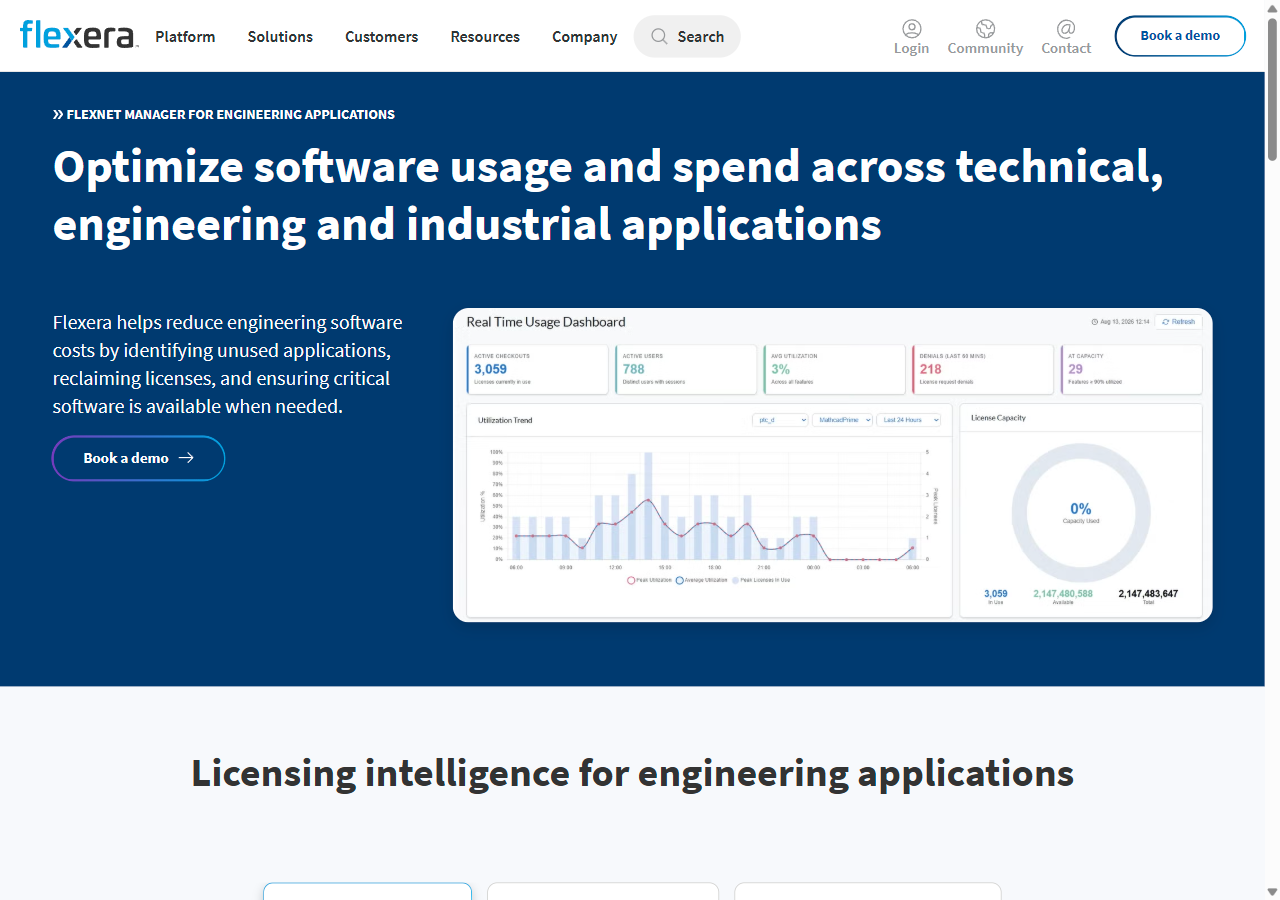
FNMEA es el módulo de Flexera para la gestión de licencias de ingeniería, que abarca las categorías de CAD, EDA, SIG, exploración y producción, y PLM para clientes de los sectores de la fabricación, la ingeniería, la energía, la tecnología, las finanzas y la administración pública. Su soporte principal es FlexLM, aunque Reprise (RLM) y Sentinel pueden integrarse a través de un configurador independiente; LM-X y BetaLM figuran en su hoja de ruta prevista, pero aún no son compatibles en la actualidad. Es una de las pocas herramientas de esta categoría que ofrece informes sobre modelos de licencia por niveles y basados en tokens, incluidos los niveles Multiflex de Autodesk y el consumo de tokens de IBM/Cadence, lo cual resulta útil para los parques de software que utilizan dichos modelos de licencia.
En cuanto a la generación de informes, FNMEA funciona con IBM Cognos Analytics y cuenta con «configuraciones de informes clásicas» que se pueden exportar e importar entre entornos, supervisión de alertas y notificaciones de «licencias retenidas» que señalan aquellas licencias que se mantienen sin uso activo para que un administrador pueda tomar medidas al respecto. Los paneles de control en tiempo real muestran el uso actual y máximo, así como el estado del servidor de licencias o del daemon del proveedor, y los informes de reembolsos se pueden desglosar por unidad de negocio.
Merece la pena sopesar esa lista de características frente a la experiencia de los usuarios: en la página de opiniones de G2 con fecha de 2026, FNMEA cuenta con unas 77 opiniones y una puntuación media de 4,1 sobre 5. Un tema recurrente en esos comentarios es que la capa de generación de informes basada en Cognos añade una dependencia de conocimientos de BI que la mayoría de los equipos de licencias aún no tienen a nivel interno: un coste real si tu equipo no utiliza Cognos en otros ámbitos.
Ideal para: organizaciones que ya utilizan la suite FlexNet Manager Suite de Flexera para la gestión de activos de TI, que desean disponer de datos sobre licencias de ingeniería dentro de la misma suite de productos, y entornos con sistemas de licencias por niveles o basados en tokens (Autodesk Multiflex, tokens de Cadence/IBM) que FNMEA documenta por nombre.
OpenLM
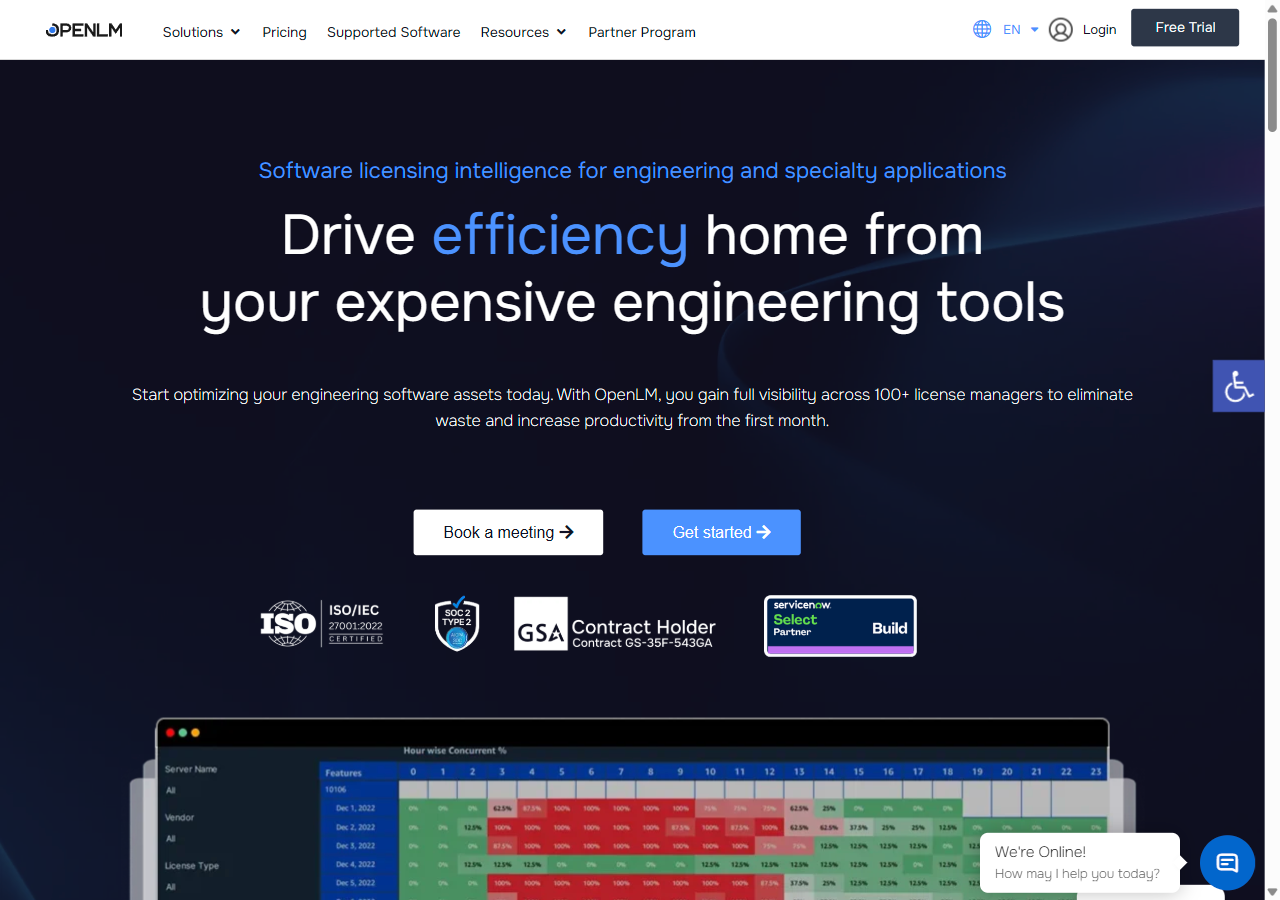
OpenLM se posiciona como «información sobre licencias de software para ingeniería y aplicaciones especializadas», y cita a Autodesk, Bentley, Sentinel, Siemens, Dassault Systèmes, Altair, IBM, Hexagon y Ansys entre los proveedores que abarca; además, en su propia página web afirma que es compatible con más de 100 gestores de licencias y más de 25 000 aplicaciones de ingeniería.
OpenLM organiza la plataforma en componentes específicos: la plataforma central de OpenLM con un módulo de análisis para la generación de informes, un módulo de supervisión de dongles para licencias con clave de hardware y un conector LDAP para la integración con directorios. Entre las funciones destacadas se incluyen la recuperación de licencias para reclamar puestos inactivos, el control de acceso a las licencias, un sistema de auditoría, un módulo de cumplimiento normativo, la sincronización de directorios, la supervisión de procesos y un centro de informes, además de un optimizador de suscripciones dirigido al ámbito relacionado con el SaaS en un entorno mixto. También ofrece el registro del uso sin conexión para trabajadores remotos y el seguimiento de denegaciones con asignación de costes.
Lo que destaca de OpenLM es la amplitud de sus integraciones con terceros: menciona integraciones con ServiceNow, Monday.com y Salesforce, más allá de las conexiones para la generación de informes que ofrece la mayoría de las soluciones de esta categoría. OpenLM afirma que, según sus casos de estudio, se produce una reducción media del 25 % en los costes de las licencias de software: se trata de una cifra facilitada por el propio proveedor, no auditada de forma independiente, por lo que conviene preguntar por la metodología subyacente antes de tomarla como referencia para tu propio entorno.
Ideal para: organizaciones que evalúan las plataformas de autoservicio en función del número de gestores de licencias y de aplicaciones declarado por los propios usuarios, y equipos que necesitan que los datos de licencias se transfieran específicamente a ServiceNow, Monday.com o Salesforce.
TeamEDA (LAMUM)
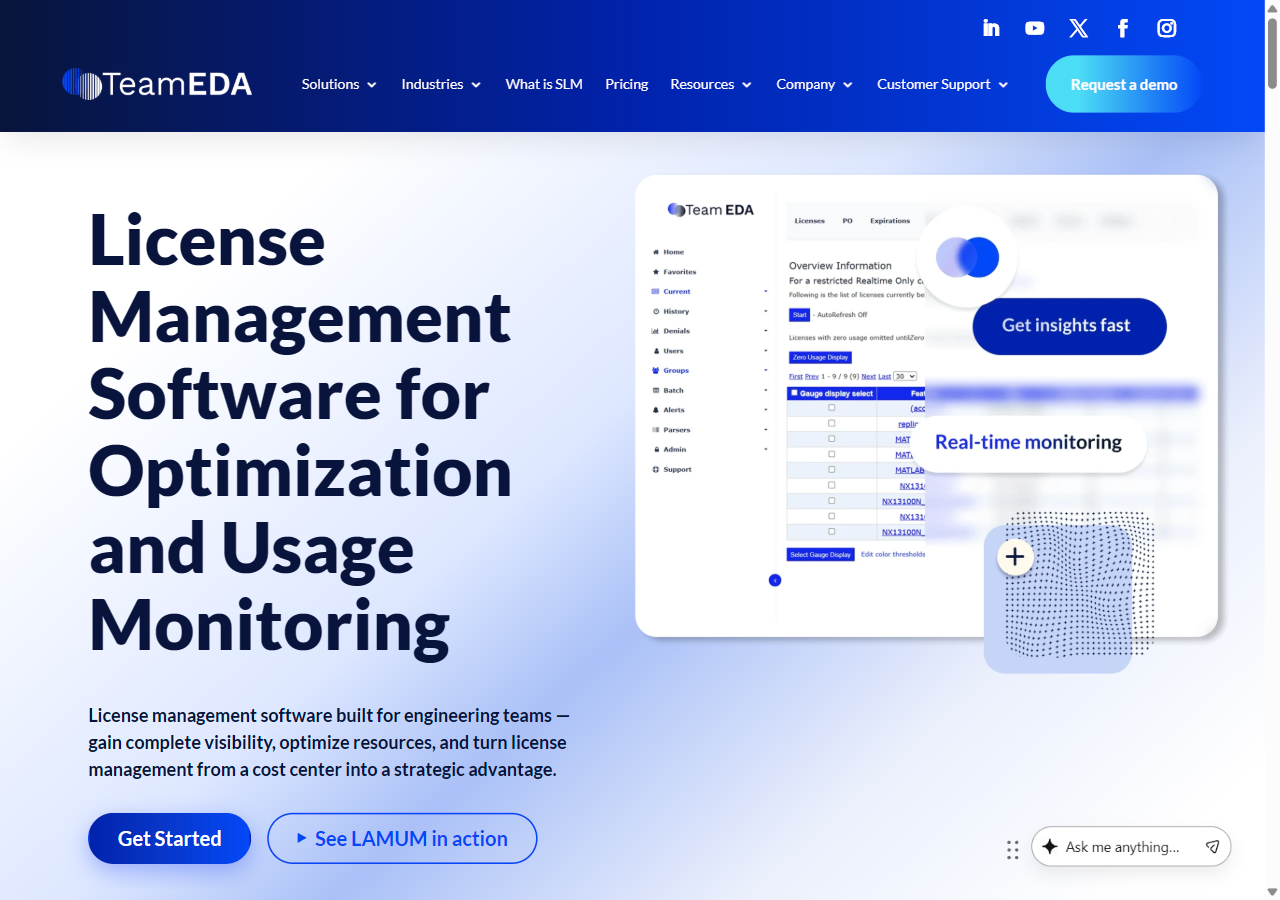
TeamEDA ofrece LAMUM (License Asset Manager with Usage Monitoring) en las versiones LAMUM Cloud o LAMUM Pro, con Agent Monitor y Advanced Analytics como complementos. Es la lista de gestores de licencias más amplia de esta comparativa: FlexLM/FlexNet, RLM, DSLS, LUM, LM-X, Sentinel HASP/LDK, Sentinel RMS, Hardlock, Codemeter, Green Hills Software, Eplan License Manager, Moldex3D, MathLM, así como las licencias de Atlassian y Altium: una lista más extensa que la publicada por OpenLM o FNMEA, que incluye varios gestores especializados (Eplan, Hardlock, Green Hills) que ninguno de esos dos menciona en absoluto.
Entre las aplicaciones de ingeniería destacadas se incluyen Siemens NX, PTC Creo, CATIA de Dassault Systèmes, SolidWorks, Autodesk, Ansys, Cadence y Synopsys. Entre sus funciones destacan los paneles de control en tiempo real y el análisis de tendencias históricas, las referencias entre herramientas para relacionar los patrones de uso con el número de denegaciones, y la recuperación de puestos inactivos. LAMUM también realiza un seguimiento del uso a nivel de funciones (qué capacidades utilizan realmente los ingenieros dentro de un producto integrado) y ofrece planificación de la utilización entre diferentes zonas horarias para equipos globales, así como modelización de escenarios para evaluar las configuraciones de licencias antes de confirmarlas. En el ámbito administrativo, ofrece recomendaciones sobre políticas relativas a la duración de los préstamos, alertas sobre incumplimientos de las políticas y préstamos prolongados, y revisiones trimestrales del estado del sistema.
TeamEDA cuenta con una amplia gama de clientes en diversos sectores, entre los que se incluyen el aeroespacial y de defensa, el automovilístico, el manufacturero, el de la electrónica y los semiconductores, la investigación científica, el energético, el de dispositivos médicos, el de arquitectura, ingeniería y construcción (AEC) y el de la automatización industrial.
Ideal para: organizaciones que busquen una opción implementable en la nube (LAMUM Cloud) y la cobertura más amplia de gestores de licencias específicos de esta comparativa, especialmente aquellas que utilicen gestores especializados como Eplan, Hardlock o Green Hills Software, que las plataformas más grandes no incluyen por su nombre.
Estadísticas de licencias de X-Formation
«License Statistics» es un panel de control basado en navegador que permite supervisar el uso de licencias en LM-X, FLEXlm/FlexNet, IBM LUM, DSLS, Sentinel RMS y servidores de licencias personalizados. Entre sus funciones destacan los informes de uso en tiempo real e históricos, las tasas de utilización por usuario, el seguimiento de denegaciones, la función «License Harvesting» para liberar automáticamente las licencias inactivas y las alertas por correo electrónico en caso de alta utilización o interrupción del servicio del servidor. Además, ofrece integración con LDAP/Active Directory y una API para la extracción de informes.
La interfaz funciona íntegramente en el navegador, sin necesidad de instalar ningún módulo adicional. Su lista de gestores de licencias es más reducida que la de TeamEDA o la de Open iT, pero abarca el conjunto básico que la mayoría de los entornos de ingeniería utilizan en la práctica: FlexLM/FlexNet, sistemas compatibles con RLM a través de soporte de servidor personalizado, IBM LUM, DSLS y Sentinel RMS. A diferencia de OpenLM, FNMEA y TeamEDA, la propia página web de X-Formation no menciona por producto a ningún proveedor específico de aplicaciones de ingeniería: describe la cobertura de forma genérica como la supervisión de «miles de aplicaciones diferentes» que se ejecutan en los gestores de licencias mencionados anteriormente. Un posible comprador tiene que verificar directamente su propia lista de aplicaciones en lugar de compararla con una tabla publicada.
Ideal para: entornos de ingeniería más pequeños o reducidos que buscan un panel de control más ligero y autohospedado que abarque el conjunto básico del gestor de licencias, sin necesidad de evaluar todas las funcionalidades de una plataforma más amplia; una herramienta más específica para una tarea más concreta, de forma deliberada.
Cada sector cuenta con un parque de ingeniería diferente
Las herramientas mencionadas resuelven el mismo problema estructural (el proceso de pago no se utiliza), pero lo que eso supone en el día a día depende en gran medida del sector en el que se desarrolle tu negocio.
En el sector de la automoción, la presión es tanto normativa como financiera: CATIA, 3DEXPERIENCE y los grupos con licencia DSLS se encuentran dentro de los mismos registros de auditoría de licencias y uso que los proveedores de software y el departamento interno de TI ya examinan minuciosamente, y las implementaciones en Europa conllevan la restricción añadida de que los datos de uso a nivel de usuario pueden dar lugar a la codeterminación del comité de empresa —en virtud de leyes como el artículo 87(1)(6), que otorga a los comités de empresa derechos de codeterminación sobre cualquier sistema técnico capaz de supervisar el comportamiento o el rendimiento de los empleados—, así como las obligaciones del RGPD, ya que los datos de uso seudonimizados siguen considerándose datos personales según el reglamento. Por eso la seudonimización de los nombres de usuario y la residencia de datos en las propias instalaciones cobran especial relevancia en este contexto, y no se tratan simplemente como un requisito genérico de seguridad.
En el sector de los semiconductores y el EDA, el problema de la atribución es de carácter estructural más que conductual: la mayor parte del consumo de licencias en un entorno de diseño (Synopsys, Cadence, Siemens EDA, Ansys, Keysight) procede de un trabajo en una granja de servidores, un escritorio virtual o una cuenta de servicio, y no de una persona concreta que esté utilizando el teclado. Una herramienta que se limita a asociar las descargas de herramientas a los usuarios está haciendo conjeturas sobre precisamente el colectivo que más importa.
En los sectores de la energía y el subsuelo, el problema es la acumulación excesiva de módulos: los más de 70 módulos de Petrel, que se pueden licenciar individualmente, y un tiempo de arranque lento hacen que los usuarios tiendan a reservar lo que podrían necesitar en lugar de lo que van a utilizar de inmediato, y ese patrón suele constituir la partida de gasto en software más importante de la cartera.
En los sectores de la ingeniería, la fabricación y la arquitectura, la construcción y la ingeniería (AEC), los entornos de software suelen estar muy fragmentados, ya que combinan plataformas básicas de CAD, BIM, PLM y simulación con una amplia gama de aplicaciones específicas de cada disciplina, extensiones y herramientas especializadas de numerosos proveedores. El reto de gobernanza resultante no radica en que las Colecciones de Autodesk solo puedan figurar como una única partida —se dispone de informes de uso a nivel de producto y de versión para los productos que cumplen los requisitos—, sino en que las vistas de compras, derechos de uso o SAM de alto nivel pueden seguir tratando una Colección como un único paquete comercial y ocultar qué aplicaciones incluidas se utilizan realmente, quién las utiliza y con qué frecuencia. Dado que las aplicaciones de una misma colección pueden diferir significativamente en cuanto a su adopción, la importancia para el flujo de trabajo y el valor empresarial, una optimización eficaz requiere un análisis más detallado que el nivel del paquete, incluyendo los usuarios asignados, la actividad a nivel de producto, la frecuencia y la duración del uso, los accesos inactivos y la adecuación entre las necesidades reales de cada rol y los derechos que se le han asignado.
Si tu entorno de ingeniería se parece a alguno de estos (o a una combinación de los cuatro), merece la pena analizar cuál es tu carencia concreta. Reserva una demostración en Open iT y trae la lista de aplicaciones; normalmente bastan treinta minutos para decirte con sinceridad si los datos de uso cambiarían tu forma de gestionarlo.
Preguntas frecuentes
¿Qué es la gestión de licencias de software (SLM)?
La disciplina que consiste en hacer un seguimiento de quién posee una licencia de software, si se está utilizando y qué ocurre cuando no es así. En el caso de la mayoría del software comercial, se asemeja al control de inventario; en el caso del software de ingeniería, cuyas licencias se conceden por funciones y se comparten como un fondo flotante, también debe medir la actividad, no solo el registro de uso. Consulte el artículo «Software License Management 101» de Open iTpara obtener la definición general completa, los tipos de licencia y los modelos de implementación.
¿Cuáles son las mejores herramientas de gestión de licencias de software para aplicaciones de ingeniería?
Open iT, FlexNet Manager for Engineering Applications (Flexera), OpenLM, TeamEDA (LAMUM) y X-Formation License Statistics son las plataformas que se evalúan con mayor frecuencia para el seguimiento específico de licencias de ingeniería flotantes y concurrentes, a diferencia de las herramientas generales de gestión de activos de software (SAM) empresariales diseñadas para software de usuario designado.
¿Cuáles son las características esenciales de la medición de licencias de software de ingeniería?
Visibilidad de las asignaciones y denegaciones directamente desde el propio servidor de licencias, medición del uso real en el terminal en lugar de deducirlo a partir de la asignación, y recuperación automática que se activa tras un periodo de inactividad sin necesidad de que nadie cierre las sesiones manualmente. La amplitud de la cobertura del gestor de licencias y el funcionamiento del proceso de implementación y formación del proveedor son tan importantes como la lista de características.
¿Cómo puedo automatizar y centralizar la gestión de las licencias de software en un entorno fragmentado?
Automatizar la respuesta implica actuar sobre el tiempo de inactividad mediante reglas de recuperación, en lugar de que una persona cierre las sesiones manualmente. La mayoría de las plataformas de esta categoría, entre ellas Open iT, FNMEA, OpenLM, TeamEDA y X-Formation, ofrecen alguna versión de recuperación automatizada. Centralizar significa que una única consola administra directamente varios tipos de gestores de licencias; CLIMS™ de Open iTlo hace con 12 tipos de gestores desde una sola consola.
¿Se integra con ServiceNow, SCCM o SAP?
Open iT Es una de las tecnologías de medición en las que se basa la gestión de licencias de ingeniería de ServiceNow e incluye una aplicación publicada en ServiceNow Store; OpenLM también menciona una integración directa con ServiceNow. No se ha documentado ningún conector nativo para SCCM o SAP en ninguna de las cinco plataformas comparadas aquí.
¿Dónde puedo encontrar reseñas sobre productos de gestión de licencias de software que se utilizan en ingeniería?
Gartner Peer Insights, G2, TrustRadius y Capterra recogen opiniones sobre herramientas de esta categoría. Según el estudio de 2026 en el que se basa esta página, « Open iT » tiene una puntuación de 4,4 sobre 5 en 77 opiniones verificadas en Gartner Peer Insights, mientras que «FlexNet Manager for Engineering Applications» cuenta con unas 77 opiniones y una puntuación media de 4,1 sobre 5 en G2.
¿Cuáles son las mejores prácticas para gestionar las licencias flotantes de las herramientas de diseño?
Lleva un control por separado de los rechazos y de la falta de disponibilidad: un rechazo solo significa que una solicitud ha fallado, no que el fondo sea demasiado pequeño. Mide el tiempo de inactividad en el punto final antes de adquirir más licencias. Establece reglas de recuperación que se ajusten al tiempo que, de forma realista, una sesión puede permanecer abierta antes de que se considere realmente abandonada.