


- There’s no single right chargeback model. The license type decides which one is fair.
- Splitting a pool by each department’s share of total use is fair, but a department’s bill can rise when someone else uses less.
- A rate set in advance keeps each bill predictable. Finance settles the surplus or deficit once a year.
- Filters make any model fairer: ignore very short checkouts, cap daily charges, and count weekends separately.
Take for example a semiconductor manufacturing organization. Let's say it employs tens of thousands of people in more than 20 countries. Its product development and engineering happen mainly in the United States, India and Israel, and it manufactures in the US, Singapore, Israel and across Asia. It also relies on contract manufacturers and other outside providers for parts, services and some engineering work.
The organization uses Siemens NX, PTC Creo, SOLIDWORKS and Autodesk Inventor for CAD, Teamcenter for engineering data, and Ansys, COMSOL and Abaqus for simulation. Those licenses serve engineers on three continents, plus outside engineers. Somebody has to decide who pays for what.
Start with one simulation pool. Say 10 concurrent Ansys licenses cost $300,000 a year. Last year, the simulation group used them for 6,000 hours, mechanical design for 3,000 and test for 1,000.
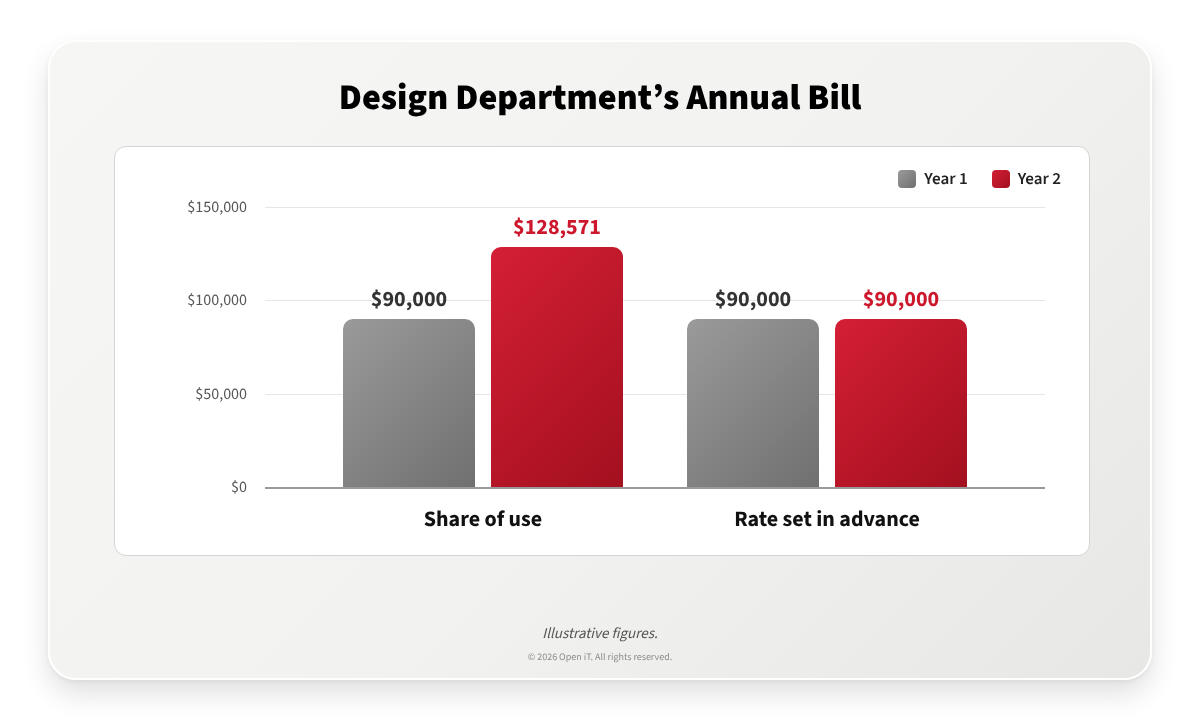
This year, design and test use the pool exactly as much as before. Simulation halves its use. Under a share-of-use model, design’s bill rises from $90,000 to $128,571, and nobody in design did anything differently.
That’s the question any IT chargeback model example has to answer: what does each department pay for, and can it predict the bill?
How do you allocate software license costs across departments? Match the model to the license. Charge named-user subscriptions per user. Charge concurrent pools by hours or by peak use, at a rate set in advance. Charge shared project work by project code. Then show the figures before anyone is billed.
Model 1: headcount split, the baseline
Each department pays in proportion to its number of users. It’s the model you can run without any usage data. It’s simple and predictable, and it ignores how much anyone uses the software. Blog 1 in this series covers why that puts cost on the wrong budget.
If engineering IT runs as a shared service, the shared services chargeback model it picks decides how each department sees its bill. The models below are the usual alternatives.
Model 2: per named user, for subscriptions
A named-user subscription is assigned to one person, whether they open the application every day or once a month. The fair metric is distinct users: each department pays for the people who hold a subscription, per month or per year.
This fits named-user subscriptions such as Autodesk Inventor in the cloud. The usage data still matters, because it shows which subscriptions nobody opened, but it doesn’t change the charge.
Model 3: share of use, a rate that moves
A concurrent pool is shared. Any engineer can take a license while one is free. The obvious split is each department’s share of the hours used, so the rate per hour moves with total use.
In the example, last year’s split was 60% simulation, 30% design and 10% test, or $180,000, $90,000 and $30,000. It’s fair: nobody pays for hours someone else used. It’s also unpredictable. When simulation halved its use, the same $300,000 was spread over 7,000 hours instead of 10,000, and design’s share rose from 30% to 43%.
Think of a bus. If you’re the only passenger on a late run, should your ticket pay for the whole trip? A moving rate says yes.
Model 4: fixed rate per hour, a rate set in advance
Set the rate before the year starts, from the cost of the service and the use you expect. In the example, $300,000 over 10,000 planned hours is $30 an hour. Design pays 3,000 hours at $30, or $90,000, whatever simulation does.
The risk moves to IT. If simulation uses 3,000 fewer hours, IT recovers $210,000 instead of $300,000. That $90,000 gap is settled once, at year end, against a profit and loss statement for the chargeback services. Open iT recommends this approach: price from actual cost and expected use, and accept that some services run a little over or under during the year. Blog 2 covers the year-end step and the showback that comes before it.
Model 5: average of daily peaks, for pools sized to peaks
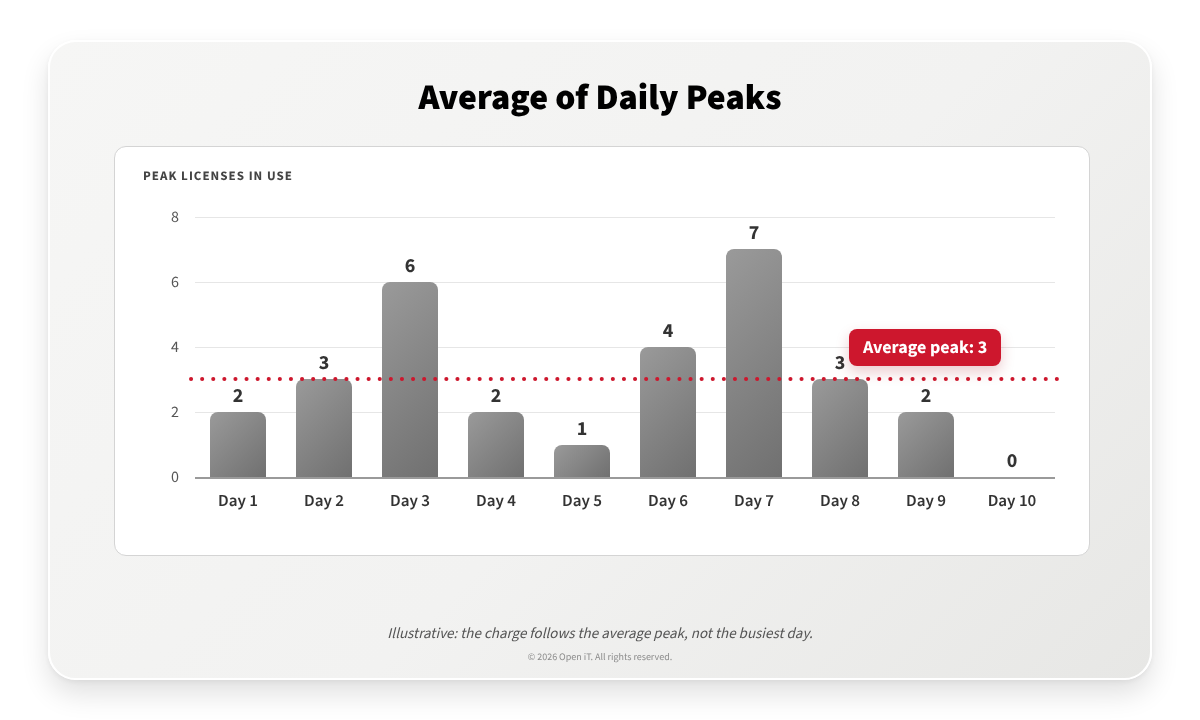
A concurrent pool is bought to cover peak demand, so hours alone undercharge the department that holds many licenses at once. In simulation, an engineer running a batch of Ansys, COMSOL or Abaqus jobs can hold several licenses for an afternoon and none the next day. Charge on peaks instead. Split the period into steps, such as days, take each department’s maximum concurrent use in each step, and average those peaks over the period.
Averaging matters. One busy day doesn’t swallow a project’s software budget, and the department that keeps many licenses open at peak still pays for it.
Model 6: fixed fee plus usage, for a predictable floor
Some departments want a bill they can plan around. Charge a fixed fee that covers an agreed level of use, and charge use above that level at a set rate. If the fee is zero, the charge is pure usage. If the rate is zero, it’s a flat fee.
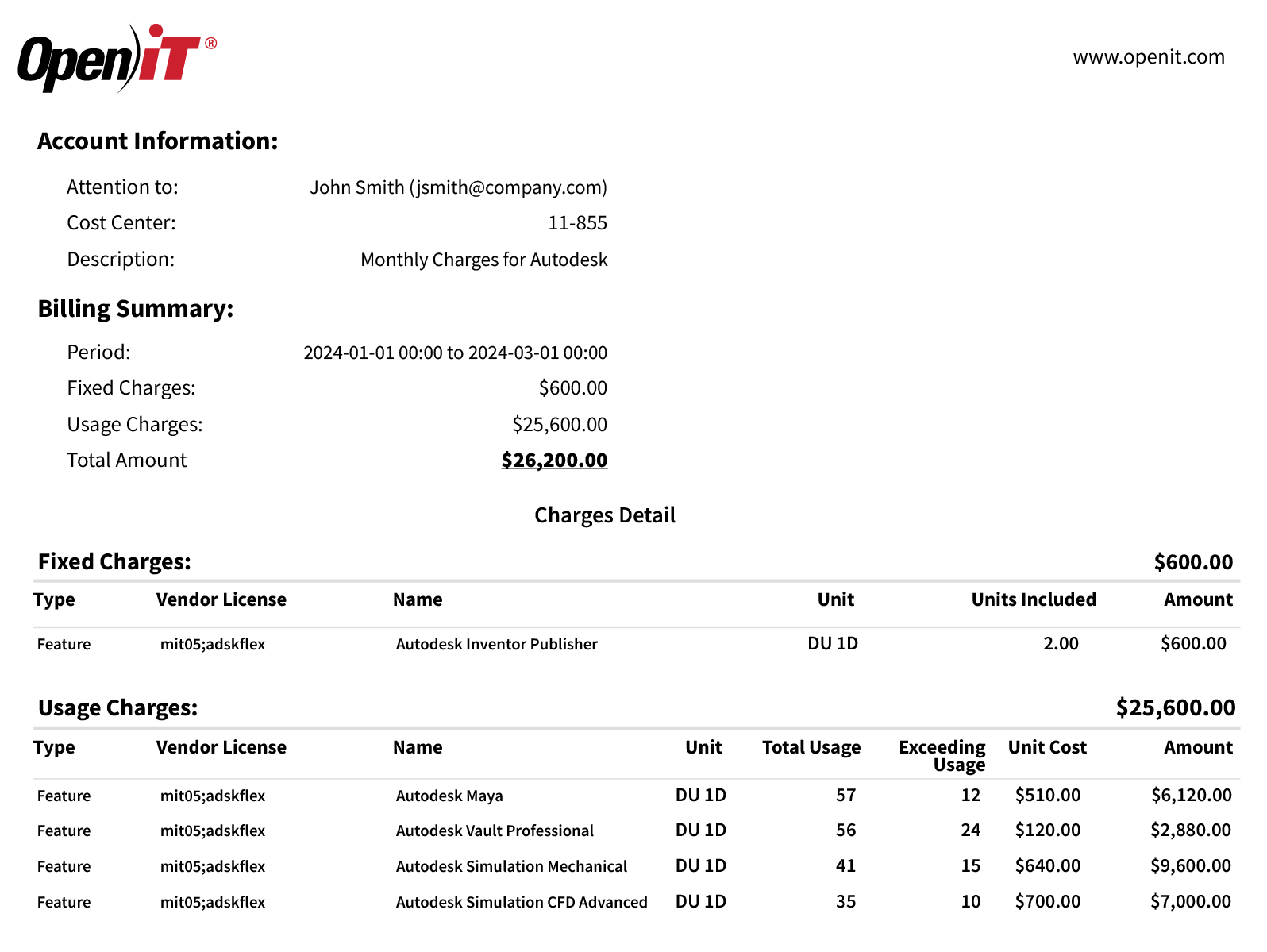
The fixed fee buys a predictable floor, not a license held free for that department. On the invoice, it shows as two lines: fixed charges and usage charges.
Model 7: per project, for people who work on several
Engineers often work on more than one project in a day. Charging their department doesn’t tell finance what each project cost. Charging by project code does.
The user registers the project they’re working on, through an application launcher or a project ID setting, and their usage carries that code. In the scenario, that’s how a new tool platform’s design and simulation work reaches the program that pays for it, wherever the engineers sit.
Filters that make any model fairer
The model sets what you charge for. Filters decide which use counts.
- Ignore checkouts shorter than a few minutes. Some pay-per-use agreements already ignore checkouts under 5, 10 or 15 minutes, and the internal charge can follow the same rule.
- Stop adding charges after a set number of hours per user per day.
- Count several copies of the same application on one user’s workstation as one.
- Leave weekends and holidays out, or price them lower.
- When a global agreement serves several regions, align each region’s day on its local time.
Rates can also depend on where and what. The cost catalog can hold different rates for the same application by cost center location or by application version.
The scenario: one engineering team on three continents
Back to the semiconductor manufacturer. Here’s how the models would fit together.
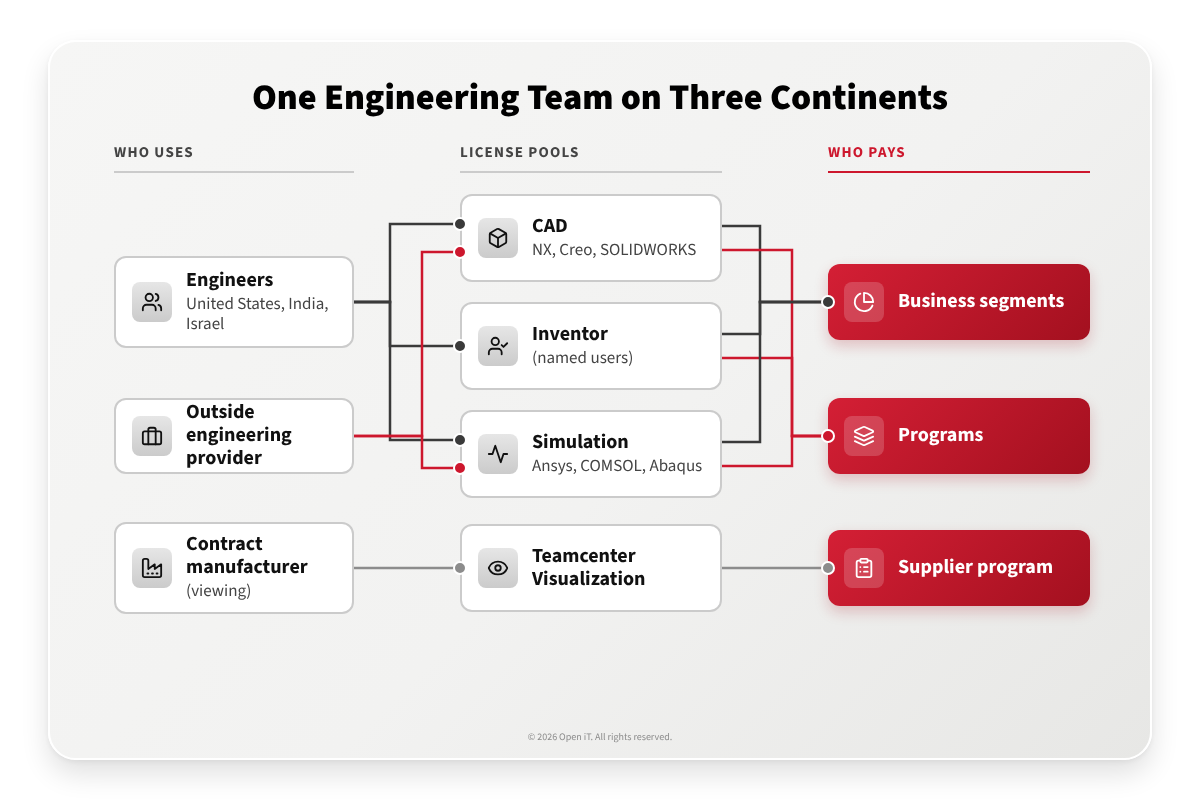
- CAD: NX, Creo and SOLIDWORKS are steady daily work, so concurrent CAD pools get a fixed rate per hour, set in advance. Named-user Inventor subscriptions are charged per user.
- Simulation: Ansys, COMSOL and Abaqus run in bursts, including for advanced packaging. Charge these pools on the average of daily peaks, so a week of heavy runs before a design review doesn’t swallow a team’s budget.
- Three time zones: A pool shared by the US, India and Israel can be busy almost around the clock. Align each site’s day on its local time. If a site buys licenses at a different price, give its cost center its own rate in the cost catalog.
- Outside engineers: When an engineering provider works in the company’s tools, map its accounts to the program that hired it. The program’s cost then includes its outside engineering.
- Suppliers who only view: A contract manufacturer reviewing models in Teamcenter Visualization uses a viewing license, not a design seat. Charge that use to the supplier program so it doesn’t land on engineering’s budget.
What the company would get: each business segment sees its engineering software cost, each program carries the CAD and simulation time it used, and outside engineering stops hiding inside headcount. At renewal, procurement knows how much of each pool is used, by which site and at what peak.
Which model fits which license
| ライセンスの種類 | Fair metric | Model | Example applications |
|---|---|---|---|
| ユーザー指定型サブスクリプション | Distinct users | Per user | Autodesk Inventor (cloud) |
| Concurrent pool, steady daily use | Hours used | Fixed rate per hour | Siemens NX, PTC Creo, SOLIDWORKS |
| Concurrent pool sized for peaks | Peak concurrent use per group | Average of daily peaks | Ansys, COMSOL, Abaqus |
| Viewing only | Distinct users or hours | Per user or per hour, charged to the program | Teamcenter Visualization |
| Shared project work | Hours by project code | Per project | Any application with project registration |
A firm that runs more than one license type needs more than one model. It can charge Inventor per user, NX per hour and a program’s Ansys work per project, on one invoice per cost center.
What finance should check before choosing
- Can each department predict its bill? Rates set in advance and fixed-fee-plus-usage do. Share of use doesn’t.
- Does anyone pay for someone else’s use? Headcount does. The usage-based models don’t.
- Can a budget holder see the detail behind the charge? If not, expect a dispute at the first invoice.
- Who absorbs the gap? With rates set in advance, IT does until year end. Agree that before the first invoice.
- Can budget holders read it? Start with the one or two models that cover your most expensive licenses, and keep one invoice per cost center.
『LicenseAnalyzer 』と『LicensePlanner 』の位置づけ
LicenseAnalyzer™ meters engineering software across 100+ license managers and cloud services. In the scenario, that covers Siemens NX, PTC Creo, SOLIDWORKS, Ansys, COMSOL, MATLAB and Teamcenter Visualization through FlexNet, Abaqus through its own license manager, and Inventor subscriptions through Autodesk’s cloud. It records who used which application, when and for how long, and maps each user to a department, cost center or project.
LicensePlanner™, its plugin, applies the model. It supports allocation by maximum concurrent users per group, distinct users and elapsed time, with charges that are fixed, usage-based or both. Its cost catalog holds the rates and the pricing conditions, and Open iT applies the filters above when it processes usage. It produces invoice-style reports per cost center, department or project, for showback and chargeback.
Before you choose, Open iT can help you compare several models on representative usage. Getting the charges into your accounting system is scoped as a separate step.
See how LicensePlanner lets you allocate license cost by project or department, or read about IT chargeback at Open iT. For more on chargeback models, see our post on the chargeback model for IT services and the whitepaper Cost Allocation and IT Chargeback.
よくある質問
What is an example of an IT chargeback model?
A fixed rate per hour for a shared pool of concurrent licenses. Divide the pool’s annual cost by the hours you expect to use, charge each department for its hours at that rate, and settle any surplus or deficit at year end.
How do you allocate software license costs across departments?
Match the model to the license. Charge named-user subscriptions per user, concurrent pools by hours or peak use at a rate set in advance, and shared project work by project code.
Which chargeback model is the most predictable for departments?
A rate set before the year starts, or a fixed fee plus a usage rate above an agreed level. Both keep one department’s bill independent of other departments’ use.
How do you charge for a license pool that is sized for peak demand?
Average each department’s daily peak concurrent use over the period, and charge that average at a rate set in advance. One busy day doesn’t dominate the bill, and peak use still costs more than steady use.
See your engineering licenses split by department
Your departments will want to know what they pay for and why. Schedule a live demo and we’ll show how LicenseAnalyzer and LicensePlanner allocate engineering software cost by user, by peak and by project.