

Aérospatiale et défense
Engineering software asset management for air-gapped and classified defense environments
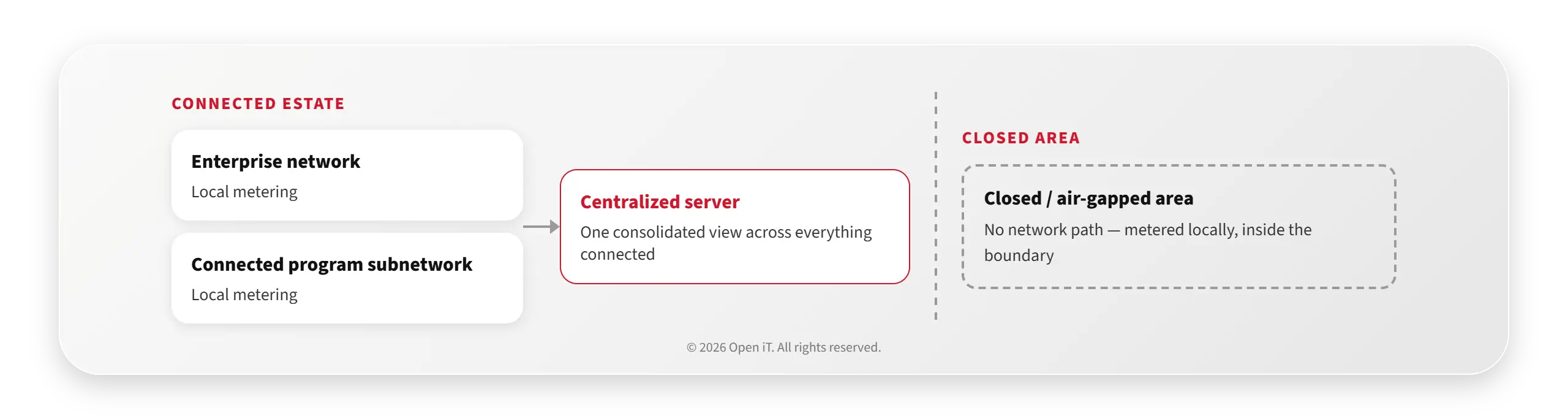
Metering, reporting and analysis all happen within the enclave, so nothing has to cross the boundary for the system to work. Where an estate spans an enterprise network, connected program subnetworks and closed areas, each environment is metered where it sits and the architecture is built around your security governance.
Air gaps are the normal operating condition in aerospace and defense rather than the exception, alongside frozen software baselines, cleared personnel requirements and data your software asset management vendor is never allowed to see. Those constraints are why the closed side of an estate ends up the least measured part of it, and where most ESAM tools fail.
01
Everything runs inside the enclave, including the analysis
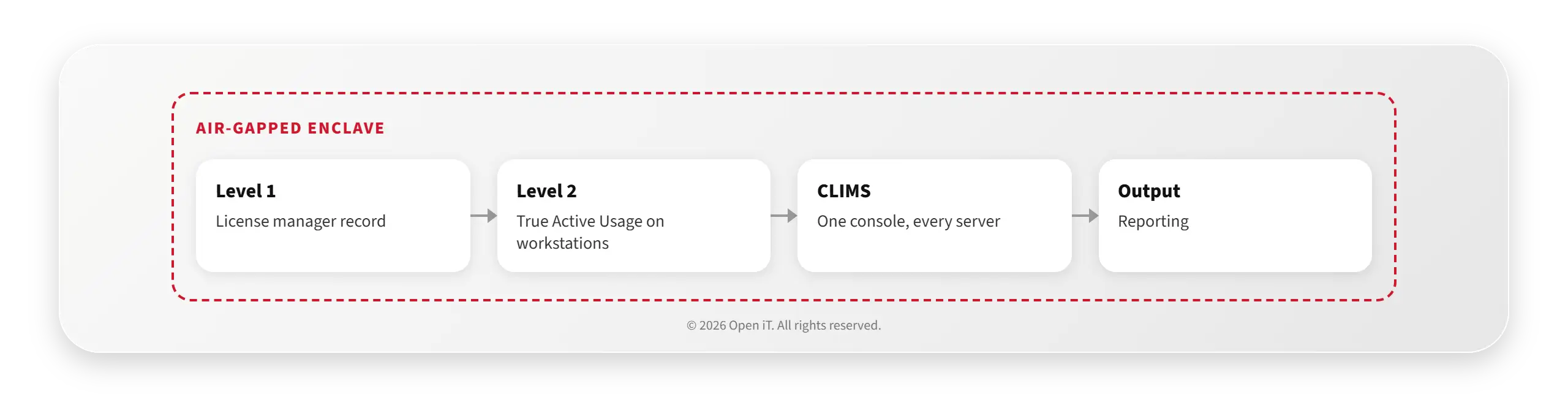
Open iT installs as a complete, self-contained deployment inside a closed or air-gapped area. Level 1 collects the license manager record, Level 2 measures True Active Usage on the workstations, and CLIMS gives your administrators one console for every license server in that area. Reporting runs in there too. No component calls out, and no data crosses the boundary for the system to function.
That matters more than it sounds. A tool that meters inside the enclave but needs a cloud service to analyze the data is not an air-gapped tool. Your closed area gets the same metering, the same denial reporting and the same active-versus-inactive analysis as your open network, and it gets them without a connection.
02
Data leaves on your terms, or it doesn’t leave at all
Every site handles this differently, because every site’s security governance is different. Some customers export a periodic, anonymized data set for consolidated reporting on the open side. Others keep the closed environment entirely self-contained and report from within it. The transfer method, the frequency and what gets included are designed with your security team during implementation planning — not dictated by the product.
Data Anonymization is usually part of that conversation. It transforms user, host and application names while keeping the usage data reliable, which is what makes an extract reviewable by people who aren’t cleared for the underlying detail.
03
Connected networks roll up. Closed areas stay closed.
Where a network path exists between an enterprise network and a connected program subnetwork, Open iT sends collected data from the local environment to a centralized server — one consolidated view across everything that’s connected, with closed areas handled separately by design.
Open iT deploys on-premises, in the cloud, or hybrid, so the open side of the estate can follow whatever your IT strategy is without changing how the closed side works.
04
Frozen baselines stay frozen, and still get metered
Plenty of monitoring tools assume you’re on the current release of everything. Open iT meters through the license manager, so metering follows FlexNet, DSLS, LM-X, RLM, Sentinel, CodeMeter and the rest rather than a specific application build. Version data is captured as part of the record, so usage can be broken out by application version — exactly what you need when three programs run three different validated baselines of the same tool.
On our own software, earlier releases keep receiving maintenance. Customers in accredited environments can’t upgrade on a vendor’s schedule, and shouldn’t be asked to.
05
Cleared personnel, agreed before you sign
Security-cleared personnel are available on request. Where a program requires support staff of a particular nationality, or holding a particular clearance, that gets agreed as part of the engagement — not discovered afterwards. Bring the constraint to the scoping conversation and it becomes part of the plan.
06
We train your people because we’re not allowed to see your data
In a classified environment we cannot look at your data. That rules out the usual model where the vendor runs the analysis and hands over a report. So we train your people to do it themselves, to data analysis specialist level, on your own system with your own data.
Your team can build and interpret reports, tune parameters for your applications, investigate a denial pattern, and produce the evidence a renewal or an audit needs — without anyone outside your organization seeing a single record.

07
ISO/IEC 27001, and nothing leaves your infrastructure
Open iT holds ISO/IEC 27001 certification for information security management.
Beyond the certificate, the security posture that matters for this vertical is architectural. The system installs on your infrastructure, in your enclave, under your access control. SSO runs through Microsoft Entra ID with SAML 2.0 and multi-AD-group support, or Okta. Role-based access separates administrators holding full management rights from users with monitoring-only access, so a console login cannot change a configuration by accident. Data Anonymization removes personally identifying detail without degrading the analysis. CLIMS records every license-management event, an audit trail the product documentation lists as relevant to regulated industries including aerospace and defense.
08
6,000+ applications. 90+ license managers.
We meter more than 6,000 engineering and specialty applications like ANSYS, NASTRAN, LS-DYNA, Abaqus CATIA, SOLIDWORKS and Simulia, Altair HyperWorks and OptiStruct, MATLAB; Green Hills Software for embedded development. Across the whole product 90+ license managers are supported.
09
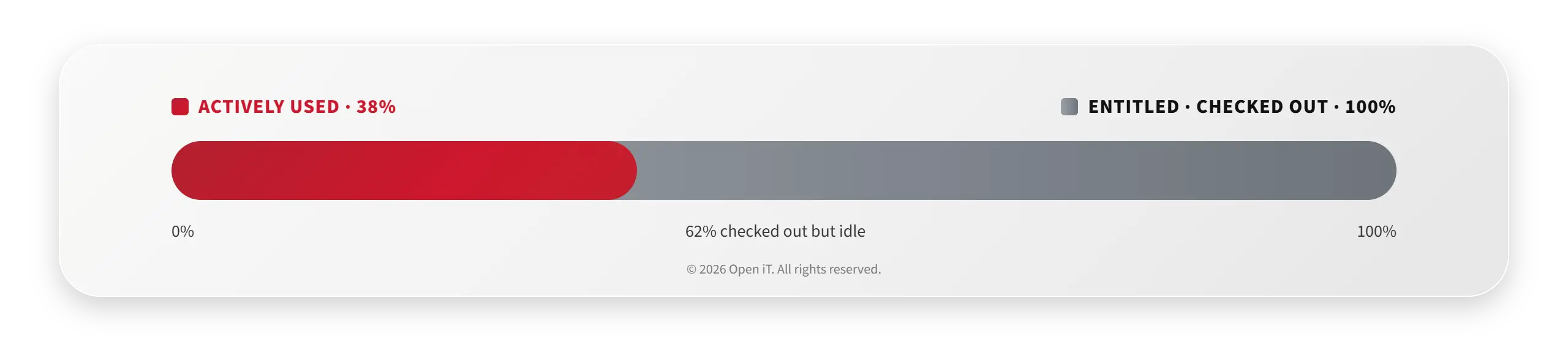
Checked out is not the same as used
We collect data from a variety of sources, regardless of licensing model, and provide specialized, robust reporting that increases visibility across the IT estate. We meter active and inactive software usage — not just check-in and checkout — finding opportunities for cost reduction, cost avoidance and process optimization.
10
Every acquisition brings licenses you already pay for twice
Acquisitions are how this industry grows, and every one arrives with duplicate agreements, overlapping entitlements and another set of license servers nobody has mapped. CLIMS™ brings the acquired license servers into the same console as yours.
SSAD, Open iT’s normalized software catalog, matches and standardizes publisher and title data so the same product bought twice under two different names stops looking like two products. License Planner™ holds the vendor and contract detail for both estates and consolidates estimated, budgeted and actual spend — how the overlap becomes visible before you renew both agreements. The usual outcome: acquired teams run on reclaimed capacity instead of new purchases.
11
Cost traced to the program that spent it
License Planner™ maps usage against financial, contract and organizational data. Cost Centers group usage by department, project, location or business unit. Chargeback and showback allocate cost to whoever consumed it, in a form a program manager or an auditor can follow.
License Cost Simulation runs the scenarios before you commit — reduce seats by 20%, move to a token model, consolidate two agreements. License Predictor™ projects usage eighteen months out.
12
It plugs into the stack you already run
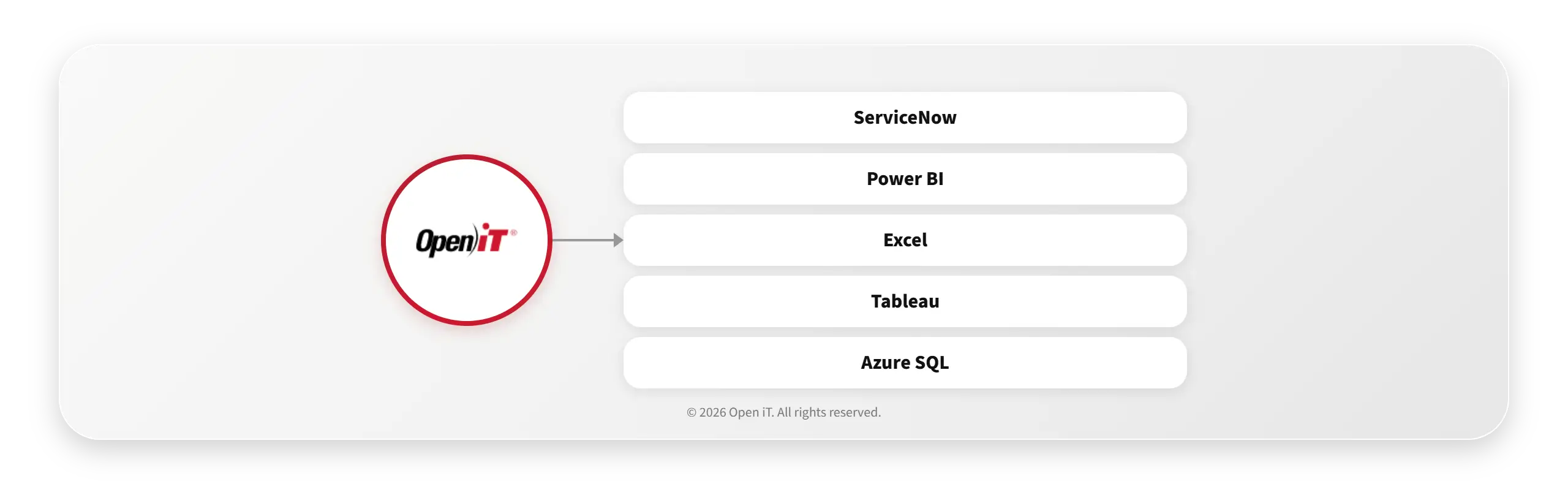
Open iT feeds your existing stack rather than replacing it. For ServiceNow, the LicenseAnalyzer™ Store App and the ServiceNow Adapter surface usage data alongside its cost tracking and entitlement management, identifying over-licensed and underutilized software. SSAD normalization is required for that integration to be accurate.
Reporting runs through a native Power BI connector and templates, direct Excel connections, or Tableau. Azure SQL and Azure Analysis Services are supported where a cloud analysis server suits the open side of the estate. SCCM and MECM inventory data can be pulled in. CLIMS™ alerts route to email or to a Microsoft Teams channel by webhook.
13
Audit-ready whenever you need it
Your largest engineering vendors reserve the right to ask, and they set the clock. Ansys requires a multi-site usage report drawn from the license manager, listing site locations, machine identifiers, time, date and hours of access per license, within twenty days of request. Dassault Systèmes requires records within three business days and machine access with audit-tool execution within two.
Level 1 keeps a usage audit trail for compliance and historical review. Denial Reports capture who was denied, why and when. Ansys’s own terms state the customer is not obligated to include personal information in that report, which is where anonymization earns its place.
14
Where Open iT stops, and what picks up from there
Worth knowing before the demo, because it shapes the architecture.
Open iT is a metering and optimization system, not an entitlement repository. Purchase orders, entitlement records, allocation workflows and change management belong in your SAM platform, which is why defense estates typically run a SAM platform for what they own and Open iT for what gets used, joined through the ServiceNow integration and SSAD normalization.
Implementation is a project, not a download. It needs a documented inventory of servers and applications, a nominated application list for Level 2, access to license servers and workstations, and named subject-matter experts for the products being metered. In closed environments it also needs your security team in the room early, because the data-handling design is part of the implementation rather than an afterthought.
15
Start with the constraint, not the requirement
Bring us the constraint, not just the requirement. Which areas are closed, which baselines are frozen, what your personnel rules are, and which applications matter. The architecture gets built around those answers.
Start with a Level 1 usage assessment. It meters one renewal cycle across your license servers and shows the gap between the capacity you own and the capacity anyone worked in, and in a closed area it runs entirely inside the boundary.
En savoir plus
Five questions this vertical asks most
Simulation & Analysis (CAE)
The most expensive seats in the estate are idle inside jobs that look busy.
CAD & PLM
You can see every CATIA seat and you cannot harvest one. Here is what to do instead.
Program Cost Allocation & Chargeback
Software cost that no program owns is cost nobody defends.
Vendor Audit Readiness
Your Ansys contract gives you twenty days. Your Dassault contract gives you two.
Closed & Restricted Networks
Your closed areas hold the most expensive software and the least data about it.