

- ServiceNow SAM Pro vous indique ce qui est détenu, détecté et installé. La rubrique « Utilisation » vous indique ce dont vous avez réellement besoin.
- Les logiciels d'ingénierie font l'objet de licences qui ne se limitent pas au niveau du produit, mais portent sur des fonctionnalités, des modules, des offres groupées et des jetons ; par conséquent, les rapports établis au niveau du produit masquent les véritables facteurs de coût.
- L'intégration des données d'utilisation dans ServiceNow modifie le cercle des personnes habilitées à les exploiter. Les équipes chargées des achats, des contrats et de la gestion des actifs informatiques (ITAM), ainsi que les dirigeants, utilisent ces mêmes données sans avoir à recourir à un outil spécialisé de gestion des licences.
ServiceNow SAM Pro vous indique quels logiciels sont détenus et installés. Il ne vous indique pas ceux qui sont réellement utilisés — et dans le domaine des logiciels d'ingénierie, c'est justement cet écart qui détermine le renouvellement.
ServiceNow SAM Pro vous indique les licences détenues et celles identifiées lors de l'inventaire. Les équipes d'ingénierie ont besoin d'une information supplémentaire : ce que les utilisateurs utilisent réellement. L'attribution d'une licence ne correspond pas nécessairement à une utilisation productive. Open iT ajoute la couche d'utilisation technique (utilisateurs, fonctionnalités, concurrence, refus d'accès et comportement actif/inactif) et l'intègre à ServiceNow, en complément des données relatives aux droits d'accès et aux coûts déjà présentes.
Ce à quoi SAM Pro répond, et ce à quoi il ne répond pas
Chaque renouvellement de licence de logiciel d'ingénierie ou de logiciel spécialisé se résume à deux questions.
Quels sont nos actifs et quels sont les équipements installés ? SAM Pro répond à cette question, et il le fait très bien. Inventaire, normalisation, rapprochement avec les registres des droits : voilà en quoi consiste le travail, et ce n'est pas une mince affaire.
Qui l'a réellement utilisé, à quelle fréquence, et quelle valeur cela a-t-il apporté ? Un registre des droits n'a jamais été conçu pour répondre à ces questions. La conformité vous indique ce dont vous disposez. L'utilisation vous indique ce dont vous avez besoin.
Le renouvellement lui-même fait l'objet d'une négociation en fonction d'un nombre de licences, et c'est l'une des deux parties qui propose ce chiffre. Si une organisation ne dispose pas de données d'utilisation indépendantes, les décisions de renouvellement reposent souvent sur les quantités prévues dans le contrat, l'historique des achats ou les recommandations du fournisseur, plutôt que sur une demande mesurée.
« Installé » ne signifie pas « utilisé ».
Une CMDB peut vous indiquer que Petrel est installé. Elle a besoin d'une source de données distincte pour vous indiquer si quelqu'un l'a utilisée au cours du dernier trimestre.
Le comptage des licences vous donne une idée plus précise, mais même cela peut donner une image exagérée de la réalité. Un ingénieur qui ouvre une application à 9 heures et la laisse tourner pendant une réunion, le déjeuner et une visite sur site a occupé une licence toute la journée, alors qu’il ne l’a utilisée que pendant vingt minutes. Si l’on multiplie ce comportement par l’ensemble d’un parc de licences flottantes, la demande apparente peut sembler nettement plus élevée que l’utilisation productive.
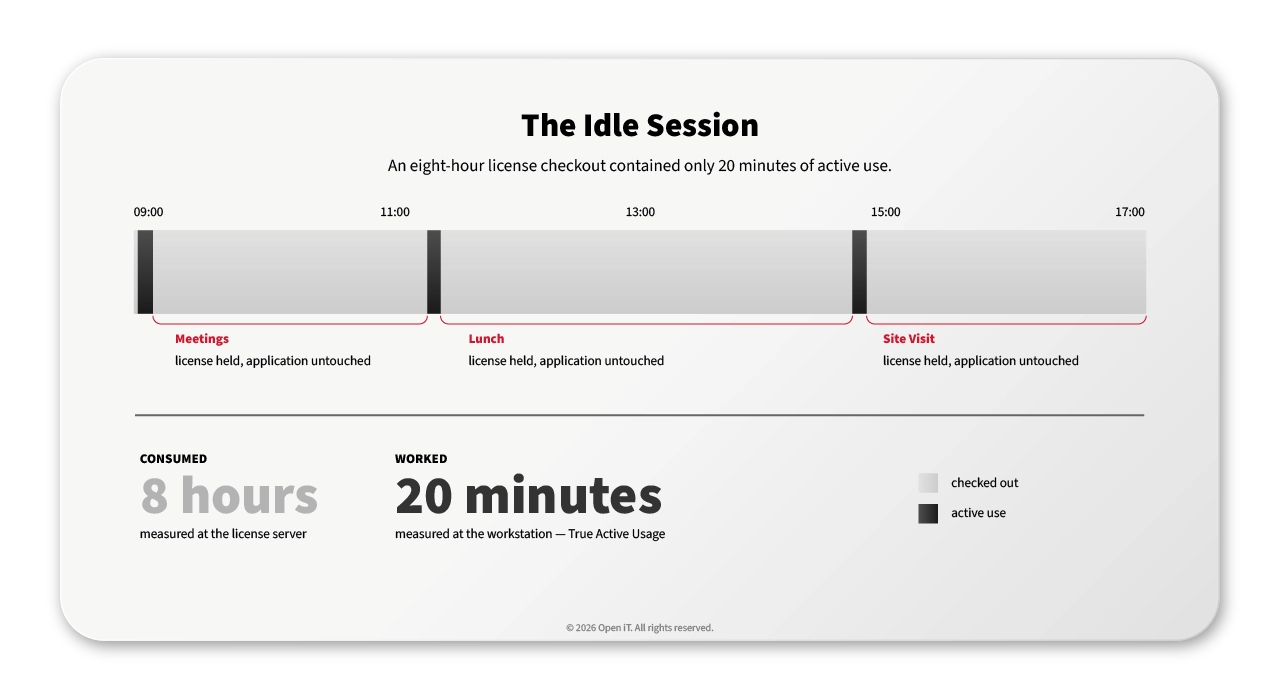
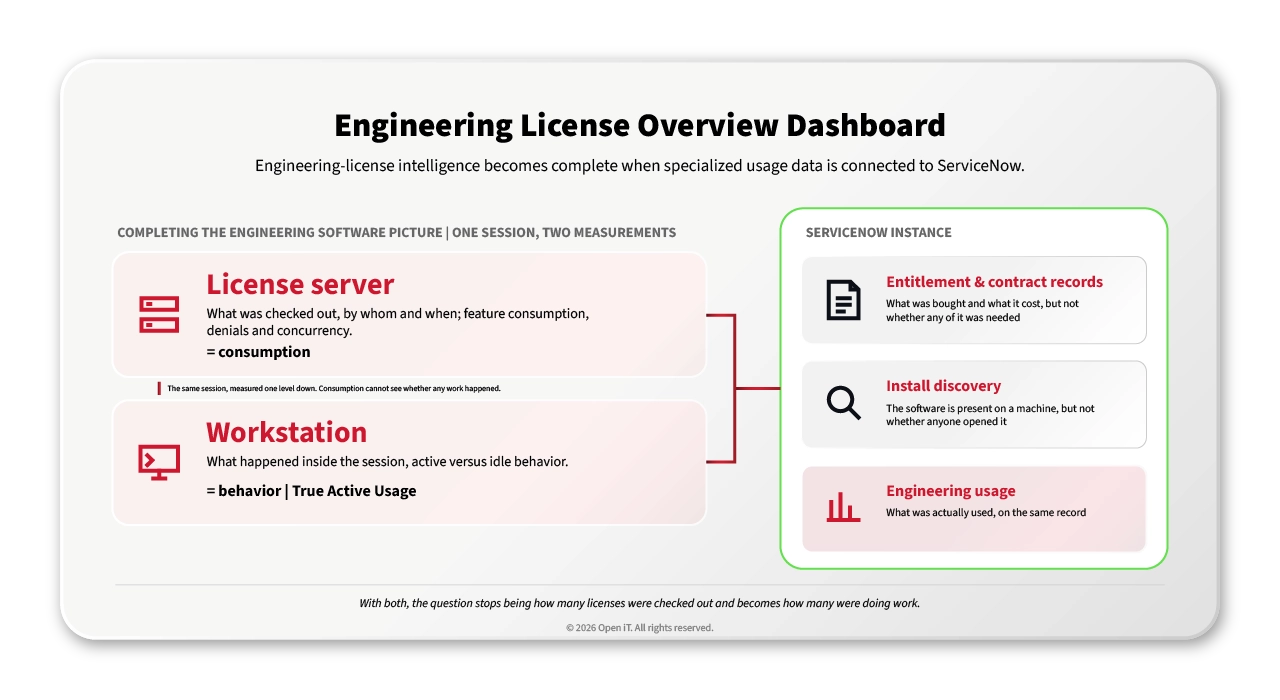
L'utilisation réelle commence lorsque l'on distingue la durée de validité de la licence de la durée d'activité de l'application. Open iT appelle ce deuxième indicateur « True Active Usage » (utilisation active réelle), et ces deux mesures proviennent de sources différentes.
| Ce que vous souhaitez savoir | Où est-elle mesurée ? |
|---|---|
| Commandes, retours, refus, concurrence | Le serveur de licences |
| Comportement actif ou inactif au sein de la session | Au poste de travail |
Conservez ces deux éléments dans des champs distincts. Les données de consommation proviennent du serveur de licences. Les données de comportement proviennent du poste de travail. Reportez-vous aux indicateurs du collecteur de niveau 2 et au rapport « Work Ratio ».
Les logiciels d'ingénierie ne se limitent pas à une seule gamme de produits
Les licences des applications d'ingénierie sont généralement accordées par fonctionnalité, par module, par ensemble de fonctionnalités, par jeton, et souvent selon une combinaison de ces éléments qui a pu changer lors du dernier renouvellement. Un seul produit commercial peut recouvrir des dizaines de modes d'utilisation distincts.
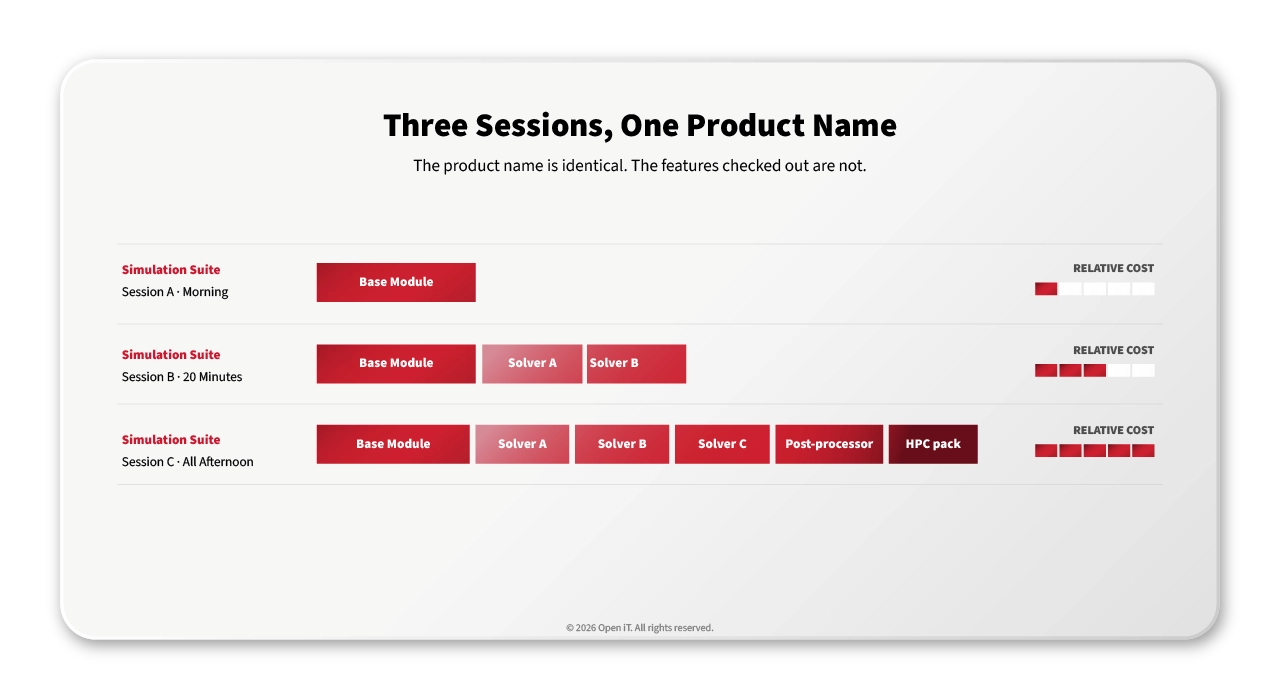
Au niveau du gestionnaire de licences, les produits sont souvent représentés par des fonctionnalités, des modules ou des composants sous licence individuels, et une seule session d’application peut en nécessiter plusieurs. Une session ne les conserve pas nécessairement tous du début à la fin non plus. Un ingénieur ouvre le module de base et rien d’autre. Un autre utilise deux solveurs pendant vingt minutes, puis un troisième exécute l'ensemble du package tout l'après-midi. Même nom de produit dans l'enregistrement des droits, trois ensembles de fonctionnalités différents effectivement utilisés, trois coûts différents. Voilà à quoi ressemblent des dizaines de schémas d'utilisation d'un même produit sur un serveur de licences.
Cette relation fonctionne dans les deux sens. Un même produit peut comporter de nombreuses fonctionnalités, et une même fonctionnalité peut être présente dans plusieurs produits, à des prix différents selon les cas. Il en résulte une relation « plusieurs-à-plusieurs » difficile à représenter uniquement à l'aide des fiches de produits.
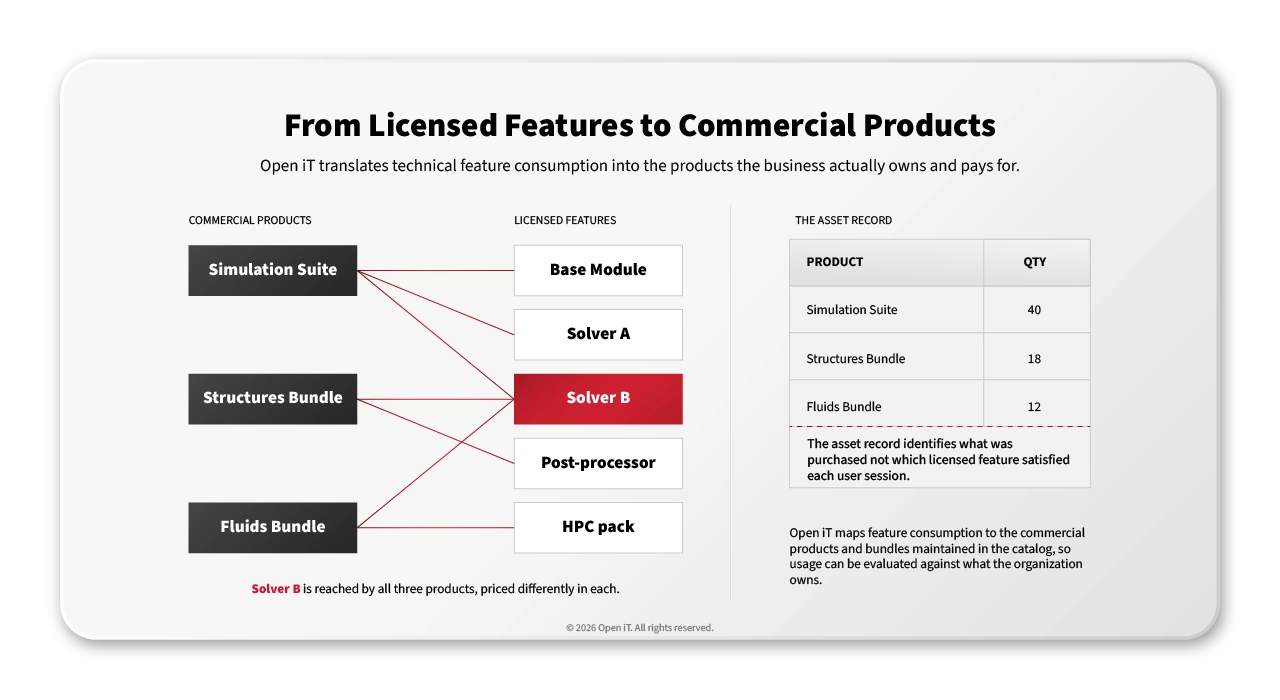
Le rapport indique donc que l'organisation est propriétaire du produit et l'utilise. Ces deux affirmations sont vraies, mais aucune n'est utile. Ce qui détermine le coût se situe à un niveau inférieur, au niveau des fonctionnalités dont personne ne rend compte.
Les cartes iT permettent de remonter jusqu'aux produits auxquels appartiennent les fonctionnalités utilisées, en se basant sur un catalogue géré de manière centralisée plutôt que reconstitué pour chaque rapport. Une ligne de la fiche d'actif indique les fonctionnalités auxquelles les utilisateurs ont accédé.
C'est cette traduction qui fait toute la différence. La facturation au compteur d'un serveur de licences est courante. En revanche, transposer la consommation au niveau des fonctionnalités dans un contexte de produit commercial sur lequel le service des achats peut agir ne l'est pas. Voir la mise en correspondance entre les fonctionnalités et les ensembles de fonctionnalités.
Une licence concurrente ne correspond pas à une installation sur un ordinateur de bureau.
Les licences simultanées sont hébergées sur des serveurs de licences. Elles sont attribuées, restituées, refusées et partagées entre les utilisateurs, parfois sur plusieurs serveurs et dans plusieurs fuseaux horaires pour une même application.
La méthode « basée sur l'installation » permet de voir que l'entreprise a installé un logiciel, mais elle ne permet pas de savoir combien de personnes ont utilisé le pool mardi, ni qui n'a pas pu y accéder lorsque le pool a épuisé ses licences.
| Source des données | Ce que cela vous apprend | Ce qu'Open iT et ServiceNow offrent ensemble |
|---|---|---|
| Installer Discovery | Le logiciel est installé sur un ordinateur | Que quelqu'un l'ait ouvert ou non |
| Dossiers relatifs aux droits et aux contrats | Ce qui a été acheté et combien cela a coûté | Se demandant si tout cela était vraiment nécessaire |
| Serveur de licences | Quelles fonctionnalités ont été consultées, quand et par qui, ainsi que les refus et le nombre maximal de connexions simultanées | La session effectuait-elle une quelconque tâche ? |
| Poste de travail | Temps d'activité et de inactivité au cours de la session | Ce à quoi l'entreprise a droit |
Open iT prend en charge plus de 90 gestionnaires de licences, notamment FlexNet, DSLS, RLM, OLicense et IBM LUM.
Deux des lignes de ce tableau permettent de déterminer si l'organisation est en mesure d'évaluer le portefeuille. Le serveur de licences vous indique ce qui a été utilisé : quelles fonctionnalités ont été fournies, quand, à qui, où la concurrence a atteint son pic et où des refus ont été enregistrés. Le poste de travail vous indique ce qui s'est réellement passé pendant cette utilisation.
Aucun de ces deux éléments ne répond à lui seul à la question relative au portefeuille. La consommation, prise isolément, s'interprète comme une demande, mais cela ne se traduit pas automatiquement par une utilisation, car certains logiciels d'ingénierie empruntés peuvent rester inactifs sur le poste de travail en raison d'une réunion, d'un déjeuner ou d'une course liée à l'école. En d'autres termes, le comportement, pris isolément, ne permet pas d'établir de comparaison.
Grâce à ces deux flux de données, la question n'est plus de savoir combien de licences ont été attribuées, mais combien étaient effectivement utilisées. Renouveler, supprimer, récupérer ou acheter : chaque décision en aval dépend de l'un ou l'autre de ces deux chiffres dont dispose l'entreprise. Voir les gestionnaires de licences pris en charge.
Il suffit d'intégrer les données dans ServiceNow pour que différentes personnes commencent à les utiliser
Le principal avantage, ce n'est pas un tableau de bord de plus. C'est un public différent.
En interne, cela se passe généralement ainsi : un spécialiste des licences élabore un classeur mensuel. C'est un travail de qualité. Deux collègues le consultent. Le service des achats l'ouvre environ deux semaines avant un renouvellement… ou pas. Le service de gestion des contrats ne l'a jamais ouvert, pas plus que leurs supérieurs, car personne ne leur a signalé l'existence de ce classeur.
Ces mêmes personnes sont déjà sur ServiceNow avant même d'avoir bu leur premier café.
Une fois que les services techniques y ont également accès, les données passent du stade de l'analyse spécialisée à celui des décisions opérationnelles. Un responsable des contrats peut s'en servir sans avoir à se former à un nouvel outil ni à demander à qui que ce soit de lui fournir un fichier d'exportation. Le rapport n'a pas été amélioré en soi. C'est son public qui a changé.
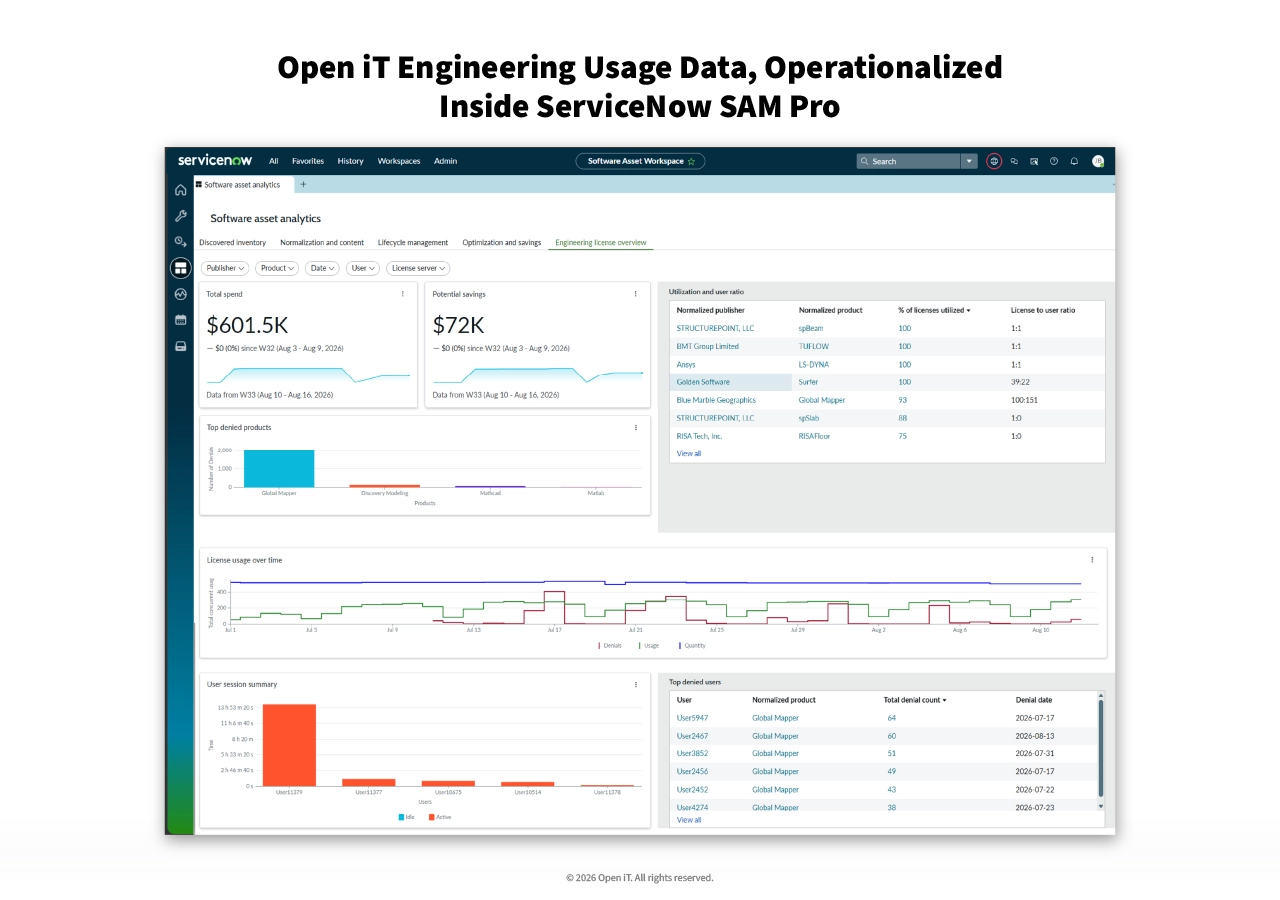
Trois flux de travail qui gagnent en efficacité lorsque les données d'utilisation sont associées à la fiche du bien
Réponse aux vulnérabilités. Le cas de Log4j, qui se répète tous les quelques mois sous un nom différent. Identifier les applications concernées, trouver le responsable, contacter l’éditeur, informer les utilisateurs. Cette dernière étape nécessite une vision à jour des personnes qui utilisent réellement l’application. Le nombre d’installations permettra d’alerter les personnes qui ne l’ont pas ouverte depuis un an, mais passera à côté du sous-traitant qui l’utilise quotidiennement.
Charge de travail du service d'assistance. Les équipes d'assistance peuvent comparer le volume de tickets au nombre réel d'utilisateurs plutôt qu'au nombre d'installations. La réponse est rarement celle à laquelle s'attend l'équipe. Les tickets provenant principalement d'utilisateurs nouveaux ou occasionnels indiquent un besoin de formation, et non un problème lié au logiciel.
Renouvellement. Le service des achats s'appuie sur des données concrètes plutôt que sur des opinions : l'utilisation, la demande et les personnes identifiées à l'origine de ces deux éléments. Où qu'ils se trouvent dans le monde, le service des achats peut contacter ces utilisateurs et leur demander à quoi sert ce poste.
L'utilisation transforme une fiche d'actif en fiche de décision.
Ce qu'apporte Open iT
Open iT ne remplace pas SAM Pro. ServiceNow reste le système dédié au cycle de vie des actifs logiciels, aux droits d'utilisation, aux contrats, aux coûts et à la gouvernance.
Open iT apporte des fonctionnalités avancées spécifiques aux logiciels d'ingénierie : consommation du serveur de licences, « True Active Usage », refus d'accès, concurrence, surveillance centralisée et capacités d'optimisation.LicenseAnalyzer™collecte ces informations et transmet les données d'utilisation pertinentes à ServiceNow, où elles viennent s'ajouter aux enregistrements commerciaux déjà présents.
Regardez notre webinaire : « Au-delà du tableau de bord : améliorer la visibilité des logiciels d'ingénierie avec ServiceNow et Open iT »
Ensemble, c'est mieux : l'analyse approfondie de l'utilisation s'allie à une gestion rigoureuse de la gestion des actifs logiciels (SAM)
Open iT recueille les informations détaillées relatives aux licences techniques. ServiceNow les relie aux droits d'utilisation, aux contrats, aux dépenses et aux workflows.
C'est en les réunissant que l'on crée de la valeur.
Envisagez-vous de passer à Nexus pour la gestion d'actifs ?
Si votre entreprise utilise des logiciels d'ingénierie, la question ne se limite plus à savoir ce que vous possédez. Il s'agit plutôt de savoir ce que vos collaborateurs utilisent réellement — et si les licences pour lesquelles vous payez contribuent réellement à la productivité.
Découvrez comment Open iT intègre les informations relatives aux licences d'ingénierie dans ServiceNow SAM Pro.
Vous comptez vous rendre au salon Nexus dédié à la gestion d'actifs ? Venez y rencontrer Open iT.