

- 連邦政府のCIOたちは、予算が横ばいのまま、巨大なIT市場を牽引するというプレッシャーに直面している。
- ソフトウェア 資産管理は、CIOが単に支出を増やすことなく、コストを抑制し、価値を高めるのに役立ちます。
- ライセンスの可視化により、優先順位付け、近代化、および連邦政府のソフトウェア ガバナンスの向上を支援します。
連邦政府のCIOたちは、世界で最も複雑なIT環境の下で業務を遂行しています。その環境とは、6兆ドル規模の市場、横ばいの予算、予算編成サイクルに関係なく継続する任務要件、そしてあらゆる方向からの監督が存在する世界です。 そのような環境下でリーダーシップを発揮するには、戦略的ビジョンと、その役職が現在責任を負うコスト、コンプライアンス、および有効性に関する意思決定を支える業務の可視性が求められます。「Open iT 」は、『LicenseAnalyzer 』を、予算が横ばいの環境下でITを率いるという現実において連邦政府のCIOを支援するプラットフォームとして位置づけています。これは、その役職が絶えず下さなければならない戦略的決定を支える分析的基盤となるものです。
連邦政府のCIOたちは、AIの導入、ゼロトラストセキュリティ、レガシーシステムの近代化、クラウドの最適化、データ駆動型の意思決定など、かつてないほど多くの技術的機能を提供することが求められているが、その一方で、予算が実質的に増額されることはほとんどない。
At the same time, global IT spending is projected to exceed $6 trillion in 2026, according to Gartner. That figure dominates industry headlines and vendor conversations, but for federal IT leaders, it often feels disconnected from operational reality.
Most federal CIOs are planning against flat or marginal budget growth, often in the low single digits, with many agencies expecting no increase at all. This gap between macro-level IT investment growth and agency-level budgets is no longer temporary. It has become the operating baseline for federal IT leadership.
需要の増加と限られた資金
Much of the projected growth in global IT spending is driven by factors largely outside the federal appropriations environment. These include hyperscale investments, large-scale AI infrastructure expansion, and concentrated capital spending by commercial technology providers.
Federal agencies operate under a very different set of constraints:
- Flat or slowly growing appropriations
- Escalating subscription and licensing costs
- Expanding mandates for AI, cybersecurity, and modernization
- Increased oversight from OMB, GAO, and agency inspectors generals
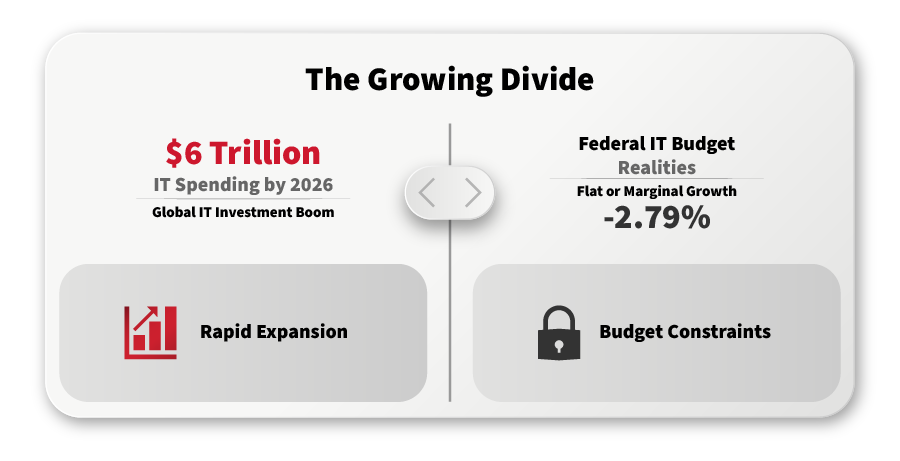
In this environment, new funding is an exception, not the rule. Modernization efforts are expected to be funded primarily by reallocating existing spending, not expanding it.
For CIOs, this means every dollar already in the IT portfolio matters. The challenge is no longer simply selecting the right technologies but finding the financial room to adopt them without disrupting mission operations.
Software: A Growing Cost Center with Limited Visibility
Software has quietly become one of the largest recurring cost drivers in federal IT portfolios—and one of the least transparent. Industry analysts project that global software spend will exceed $1.4 trillion this year.
Enterprise applications, engineering tools, analytics platforms, databases, and specialized technical software often account for a significant portion of IT spending. Yet many agencies struggle to answer basic questions about how these tools are used.
Common challenges include:
- 十分に活用されていない、あるいはまったく使用されていないライセンスの費用を支払うこと
- Maintaining higher license tiers “just in case”
- Limited leverage during vendor negotiations due to lack of usage data
- Difficulty reallocating licenses across programs or bureaus
- Incomplete visibility into high-cost technical and engineering tools
These inefficiencies are rarely intentional. They accumulate over time as organizations grow; missions shift, and contracts renew under pressure.
When budgets are flat, however, the impact becomes unavoidable. Every unused or misaligned license represents funding that cannot be applied to higher-priority initiatives such as AI pilots, cybersecurity improvements, or system modernization.
ソフトウェア の資産管理を戦略的能力として再定義する
Historically, Software Asset Management has been associated primarily with compliance and audit response. In today’s fiscal environment, that framing is no longer sufficient.
信頼性の高い利用状況分析データに裏打ちされた最新のSAM(ソフトウェア資産管理)により、CIOは以下のことが可能になります:
- 実際の需要と認識された需要を区別する
- 更新や調整の際には、証拠に基づいた意思決定を行う
- Reallocate existing assets before purchasing new ones
- 説明責任、監督、および財務報告の要件を遵守する
In this context, SAM becomes a mechanism for financial agility, not simply a control function.
WEBINAR: Software asset management is no longer just about compliance. Watch “Software Asset Management’s Hidden Value” to see how usage intelligence supports cost control, audit readiness, and mission-focused decision-making. Here’s your invitation to watch the recording.

Open iT |ウェビナー・オンデマンド
ソフトウェア 資産管理で隠れた価値を解き放つ
Open iT: Helping Federal CIOs Do More
As a GSA contract holder, Open iT supports federal agencies in strengthening software asset management and IT financial management practices through usage-based intelligence aligned with federal procurement and governance frameworks.
GSAを通じて提供されるため、各機関は、長い調達サイクルや長引く価格審査、追加の正当化作業を必要とせずに、「ソフトウェア 」の利用分析機能を導入することができます。これは、機能性と同様にスピード、コンプライアンス、リスク低減が重視される環境において、重要な考慮事項となります。
Rather than focusing on expanding procurement, Open iT helps agencies extract greater value from the software they already own, supporting modernization goals within existing budget constraints.
全社的な利用状況の可視化
Open iT delivers granular, auditable insight into software consumption across the enterprise, including:
- どのユーザーが特定のアプリケーションを積極的に利用しているか
- How frequently software is accessed
- どの機能やモジュールが利用されているか
- ライセンスが未使用または十分に活用されていない場合
This level of transparency enables CIOs to move from assumption-based planning to evidence-driven decision-making, a critical capability in federal budget formulation, audits, and oversight reviews.
追加購入の前に、既存のものを再利用・再配置する
With accurate usage data, agencies can:
- Identify and reclaim unused or underutilized licenses
- プログラム間または拠点間で権限を再割り当てする
- ライセンスの階層を実際の運用ニーズに合わせて調整する
Many Open iT customers have identified double-digit percentage savings through license reclamation and entitlement of of right-sizing—freeing funds that can be redirected to higher-priority initiatives such as AI and cybersecurity.
ベンダーとの交渉力の強化
ソフトウェア のベンダー各社が、サービスのバンドル化を進め、サブスクリプション料金を引き上げ、利用量に応じた課金モデルへと移行し続ける中、客観的な利用状況データはますます重要になってきています。
Open iT enables federal CIOs to approach negotiations with:
- 過去および現在の使用動向
- Peak versus average utilization metrics
- 過剰な許認可の前提に異議を唱えるための、説得力のある証拠
このデータ駆動型のアプローチは、よりバランスの取れた交渉結果をもたらし、長期的なベンダーロックインのリスクを低減するのに役立ちます。
FinOpsおよびIT財務管理の支援
As agencies extend FinOps principles beyond cloud cost management, software asset optimization has emerged as a natural next focus area.
Open iT supports broader IT financial management efforts by:
- ソフトウェア の使用状況をコストと直接結びつける
- Supporting chargeback and showback models
- 説得力のある予算の根拠説明と監査への対応を可能にする
この統合により、厳しい財政環境下においても、CIOが責任ある管理と価値を証明する能力が強化されます。
コスト管理から任務遂行支援へ
In 2026, Software Asset Management is no longer just about compliance or audits—it is about mission readiness.
利用状況分析に投資する連邦政府のCIOには、次のようなメリットがあります:
- 予算サイクルの制約下における財務面の機動性の向上
- 監督機関からの信頼性の向上
- 安定性を損なうことなくイノベーションに資金を投入する能力
The $6 trillion IT spending headline may dominate industry conversations. For federal agencies, measurable insight, operational efficiency, and disciplined control are what ultimately enable meaningful progress.
If flat budgets are your reality, visibility must be your advantage.
Talk to Open iT about gaining the usage intelligence needed to optimize software spend and redirect savings toward AI, cybersecurity, and mission-critical initiatives.
Open iT との相談を予約してください。