

Government, Education & Research
Software license budgets in government, education and research: the evidence behind the number you submit
Once a year you submit a figure for software licenses, and once a year somebody asks how you arrived at it. Open iT gives you the answer: how much of what you already hold was used, how much wasn’t, and what the coming cycles will need. It reports into ServiceNow, Power BI, Excel or Tableau, so the evidence arrives where your team already works.
The cycle rarely changes. A figure goes up, it gets questioned, and it comes back either intact or reduced. In between, people join, people move on, departments ask for access you can’t always grant, and a review can arrive at short notice. All of that gets easier with a record, and it’s the same record.

01
The question you get asked in the review
There’s usually one question, and it isn’t about price. It’s how you arrived at the figure. A number carried forward from last cycle invites the question. A number with a year of recorded use behind it answers it before anyone asks.
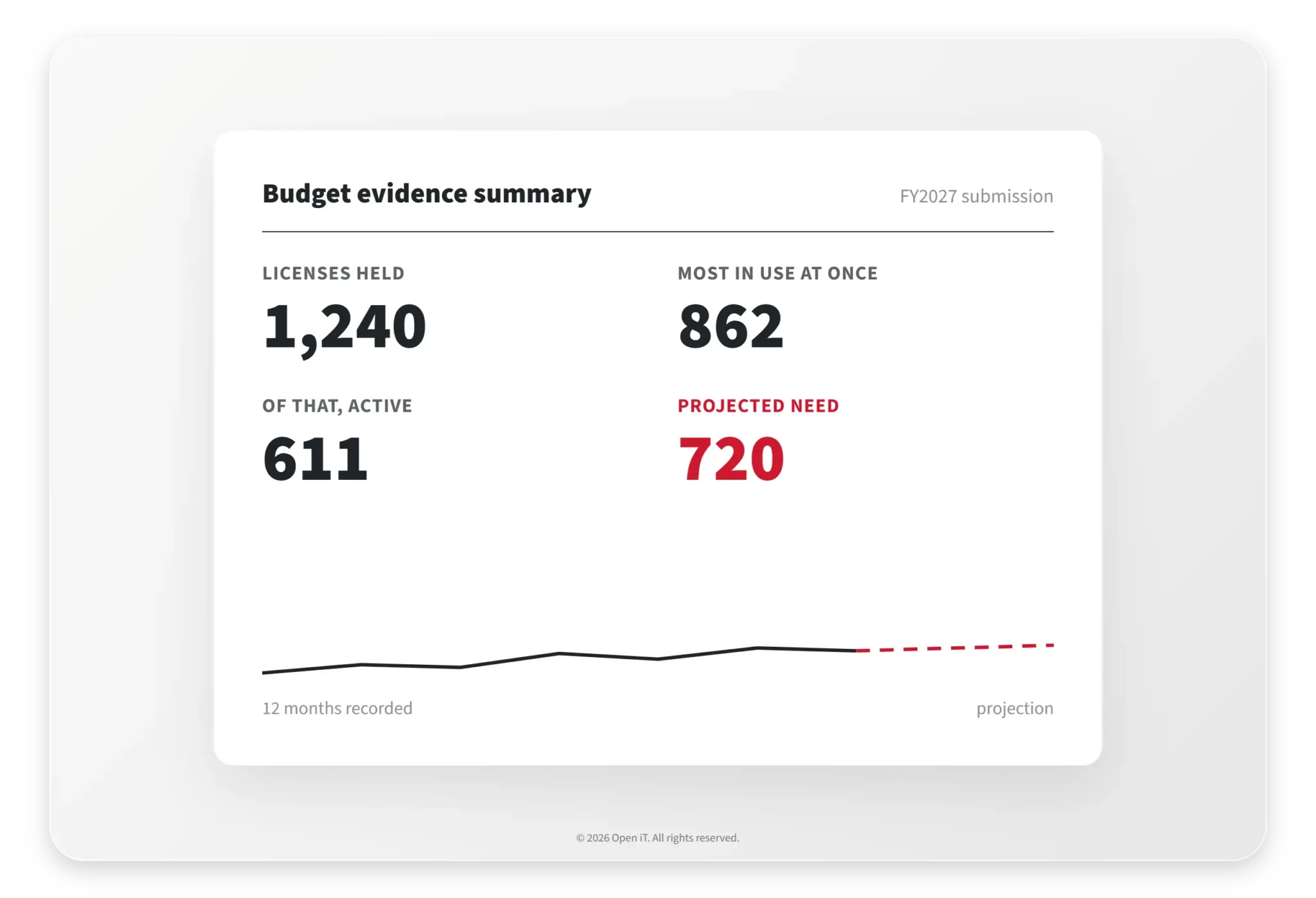
What sits in that record is straightforward. How many people held a license at the same time. How many held one without working in it. How both of those moved, month by month, across the year.
02
Where the number comes from
Two things sit underneath the figure. The first is what actually happened: a full cycle of recorded use, by product and by department, with the busy weeks and the quiet ones visible rather than averaged away.
The second is what’s coming. Open iT projects the requirement eighteen months out, which covers the cycle you’re submitting for and the one behind it. It projects from use rather than from what you happen to hold, so licenses that sat unopened all year don’t quietly carry themselves into the ask.

03
Headroom you already have
Some of what you hold isn’t in use. That isn’t a finding about anyone’s judgment. A purchase record can’t show it, so until something measures it, nobody in the building can see it.
Once it’s visible it becomes headroom: capacity you can offer to a department that’s been waiting, without adding a line to the submission. Across engineering deployments Open iT typically finds twenty to forty percent of licenses idle at any moment. On a fixed budget that isn’t a saving. It’s more people served on the same money.
04
What you can say when a department asks for more
Requests for access arrive continuously and most of them are reasonable. The hard part is answering them consistently, and being seen to.
A usage record tells you whether the department asking already holds capacity nobody is using, whether the shortage is real, and whether people were genuinely turned away and when. That turns a judgment call into a decision you can explain in one sentence, to the people who get a license and to the people who don’t.

05
When someone moves on, the license usually doesn't
Staff move between roles, departments and agencies, and a license assigned to a person stays assigned to that person. Nobody decides to leave it there. It just isn’t the sort of thing that surfaces on its own.
Open iT shows which assignments have had no activity behind them, so a move becomes something you act on this cycle instead of something you find two cycles later. Where the vendor allows it, a seat left idle can also be returned to the shared pool automatically, with the person’s work preserved so nothing is lost. That applies to some license systems and not all, and the reallocation page sets out which.
06
Fair, and able to show it
Allocation decisions in a public body get looked at, sometimes years later. Grouping use by department, faculty, project or location gives each one its own picture, and showing a department what it consumed without billing it for anything is usually the right level in an institution that doesn’t invoice itself.
It also means the answer to “why did they get one and we didn’t” is a record rather than a recollection.

07
The record, before anyone asks for it
Reviews go better when the evidence already exists. Open iT keeps a usage history for exactly that purpose, alongside a record of who was turned away and when, and of what changed in a license agreement when it changed.
Expiry sits in the same picture. Every product, its version, how many seats you hold and how many days remain, in one list. Nothing lapses without warning, and nothing gets renewed just to be safe.
08
Names stay out of it
Usage data is data about people, which makes it sensitive in an institution with staff representation and data-protection duties. Open iT can transform user, machine and application names so the reporting still works and individuals aren’t identifiable in it.
Access follows the same principle. Sign-in runs through the identity provider you already use, and the people who only need to read a report can’t change anything. Where the system itself sits, on your own premises or in cloud, stays your decision.
09
Nothing new for your team to run
The smallest version of this reads what your license servers already log. Nothing goes onto anyone’s desktop, nothing changes for the people using the applications, and nobody has to be trained to keep it running.
That matters more than it sounds. A tool that creates work is a tool you have to defend twice.

10
It reports into what you already read
Nobody replaces a working service desk or a working reporting stack in order to add a measurement tool, so Open iT feeds them instead.
Usage data goes into ServiceNow next to the entitlement and cost records already there. Power BI has a connector and ready-made reports. Excel connects directly. Tableau reads the same data. Inventory from SCCM or MECM can be pulled in, and alerts can go to email or to a Teams channel. If your reporting already lives somewhere, that’s where this arrives.
11
What it covers
More than 6,000 applications across more than 88 license systems, including the cloud portals your vendors have been moving you onto. Where something isn’t supported directly there’s still a way to read it, as long as it produces a record of use at all.
Purchases that arrive bundled are handled too, so what gets reported reflects what you actually bought rather than how the supplier chose to package it. Everything supported is listed on the supported applications page.
12
What it isn't
Open iT is a measurement and reporting system. It doesn’t hold purchase orders, entitlement records or approval workflows, and it isn’t a replacement for whatever you use for those. Most institutions keep one system for what they own and add this for what gets used, with the two connected.
Starting is a project rather than an installation. It needs a list of your license servers and the products that matter, and someone who knows how each of those products is licensed. That’s a few days of somebody’s attention, not a change program.

13
The smallest version that's still worth having
One cycle of measurement across your license servers produces four figures: what you hold, the most that was in use at once, how much of that was active, and what the next eighteen months project to. Those four figures are your submission.
Measurement is easier to fund than the budget it defends, because it’s the evidence for the larger number.
Explore Deeper
Go deeper on government license management
Unused Licenses
Idle seats, role changes and orphaned assignments: find them and reallocate before you buy more.
Budget Forecasting
Twelve months of recorded use turned into a projected need for the next budget submission.
Review Records
Usage history, expiry dates and seat counts, ready when an audit or review asks for them.
Reporting Integrations
Feed license usage into ServiceNow, Power BI, Excel and Tableau, the tools you already report in.
Build vs Buy
What it takes to build your own license monitoring from server logs, set against buying it.
Supported Applications
90+ license managers and the engineering applications Open iT meters, and what is not yet confirmed.