


- Subscription drift is unapproved growth in a software entitlement pool between one renewal and the next – no single point where the running total gets checked against actual need.
- Synopsys now draws roughly 60% of its product revenue from time-based, subscription-style licenses against 40% upfront, per its Q3 FY2026 results (the most recently reported quarter).
- Modular product families carry the highest drift exposure – Synopsys’s TestMAX (DFT, ATPG, Diagnosis, Manager, Advisor, ALE) and Siemens EDA’s Calibre (nmDRC, nmLVS, PERC, Auto-Waivers, SONR, Fab Insights) – while single core tools like Design Compiler track tape-out cadence instead of drifting.
When a semiconductor design team requests one more TestMAX DFT module to clear a tapeout deadline, the request looks small and gets approved in minutes – a single line item against Synopsys's software portfolio. The phase ends, the module stays provisioned and releasing it is nobody's specific job. Multiply that pattern across a handful of shared license pools serving several thousand engineers, and a design organization can add two dozen floating seats in a year that nobody individually approved, and nobody collectively reviewed – an accumulation that surfaces on the renewal invoice.
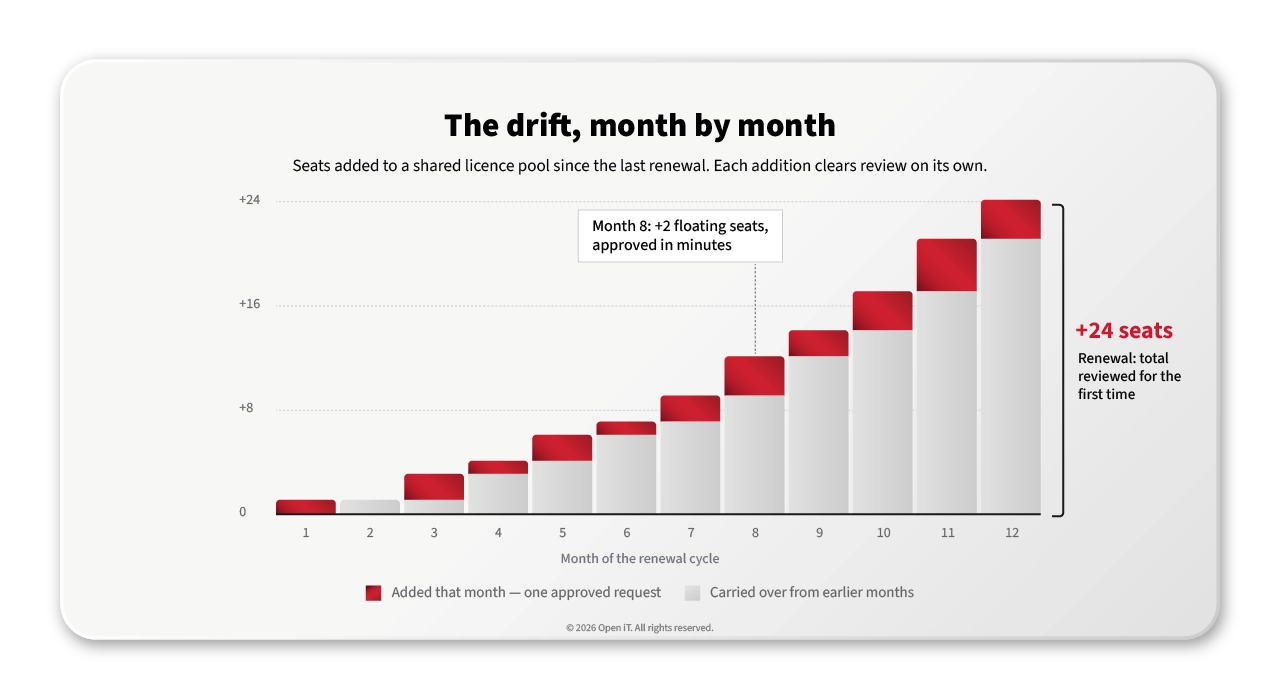
When a semiconductor design team requests one more TestMAX DFT module to clear a tapeout deadline, the request looks small and gets approved in minutes – a single line item against Synopsys’s software portfolio. The phase ends, the module stays provisioned and releasing it is nobody’s specific job. Multiply that pattern across a handful of shared license pools serving several thousand engineers, and a design organization can add two dozen floating seats in a year that nobody individually approved, and nobody collectively reviewed – an accumulation that surfaces on the renewal invoice.
Subscription drift is the slow, unapproved growth in a software entitlement pool between one renewal and the next. A seat added here, a license added there, and nobody re-evaluates any of it before the subscription or maintenance term comes up again. Each change clears review on its own. Nobody checks the twelve-month total. The entitlement count moves all year. The first time anyone sees the total is the renewal invoice.
In a semiconductor design estate, this shows up fastest in tool families with two things in common: they’re commonly sold on a renewing basis – Synopsys, for example, now draws roughly 60% of its product revenue from time-based, subscription-style licenses against 40% upfront, per its most recently reported quarter – and they’re broken into many separately-licensed modules rather than one flat product.
Synopsys’s TestMAX design-for-test suite – split into DFT, ATPG, Diagnosis, and several other add-on products – is a much easier place to lose track of what’s still needed than Design Compiler, the single core synthesis tool nearly every digital design team runs every day. Provisioning one more TestMAX module for one project phase is a small, defensible decision each time. Rolling it back after that phase ends is nobody’s job in particular.
In a design organization running its shared pools against several thousand engineers, two extra seats a month sounds trivial. Add them up for a year and the pool has grown by two dozen seats that nobody individually signed off on and that arithmetic runs quietly in the background of almost every multi-site design estate.
A drifting license pool doesn’t break any rule
A tapeout deadline gets an early-testability module provisioned for a project phase, alongside the base DFT tool the team already runs continuously. The module clears the deadline, the phase ends, and the license stays on the books – nobody’s job to release it. A design-for-test license pool expanded two years ago for one program never gets scaled back down. Each step is small, documented, and defensible on its own.
What’s missing is the view across steps. Nothing in most workflows asks whether this year’s additions, taken together, still make sense against last year’s baseline – let alone whether a given add-on module is still being opened at all. The record shows what was approved. It doesn’t show what accumulated, and it doesn’t show what quietly stopped being used once the phase that justified it ended.
For a design organization running EDA licenses across multiple sites – often several thousand engineers against a handful of shared pools for synthesis, DFT, and layout – that gap compounds fast. A design team in one location can request an additional DFT module without visibility into what two other sites already added the same quarter, or whether either site is still opening the module from last year.
Why the Usual Report Doesn’t Catch It
Most license reporting shows what was checked out, not what was actually used. That distinction matters: a checkout confirms a seat was claimed. It doesn’t confirm anyone worked in the tool for the hour, the day, or the quarter that followed.
The most common fix for this in the license-metering category is an automated reclamation rule: release a seat automatically after it’s sat checked out and idle past a set timeout. That catches the easy case – a seat left open overnight with nothing happening in it. It’s still inferring activity from the checkout clock, not measuring it.
Entitlement drift survives that gap easily. A seat added in March and rarely opened since still shows up as a normal, in-use license in any report built only from checkout logs and idle timers. The number looks healthy. Nobody looked at the usage behind it.
Signs worth checking before your next renewal
| Sign | What it usually means |
|---|---|
| The synthesis, DFT, or layout license pool has grown for several renewal cycles without anyone approving the total | Additions cleared review one at a time – the sum itself was never reviewed |
| Idle-timeout reports show healthy utilization, but nobody can name who’s actually running jobs against specific seats | A checkout-plus-timer view isn’t active use – the report is answering the wrong question |
| A renewal adjusts to “current usage” without anyone rebaselining first | Renewal leakage – this year’s drift becomes next year’s floor |
| Site or program teams request extra seats with no visibility into what other sites already added | Overprovisioning accumulates locally, and invisibly |
Two Ways to Close the Gap
Most of this category solves the first problem the same way. Where they diverge – and where subscription drift specifically slips through – is what happens after that.
The usual approach is built around the license server log: real-time availability showing who currently holds a seat, denial tracking for who got turned away and when, cost allocation split by department or project, and an automated reclamation rule that releases a seat once it’s sat idle past a set timeout. Some platforms in this category also add a subscription-optimization layer for cloud-seat reallocation, though that’s a separate mechanism from EDA-license reclamation.
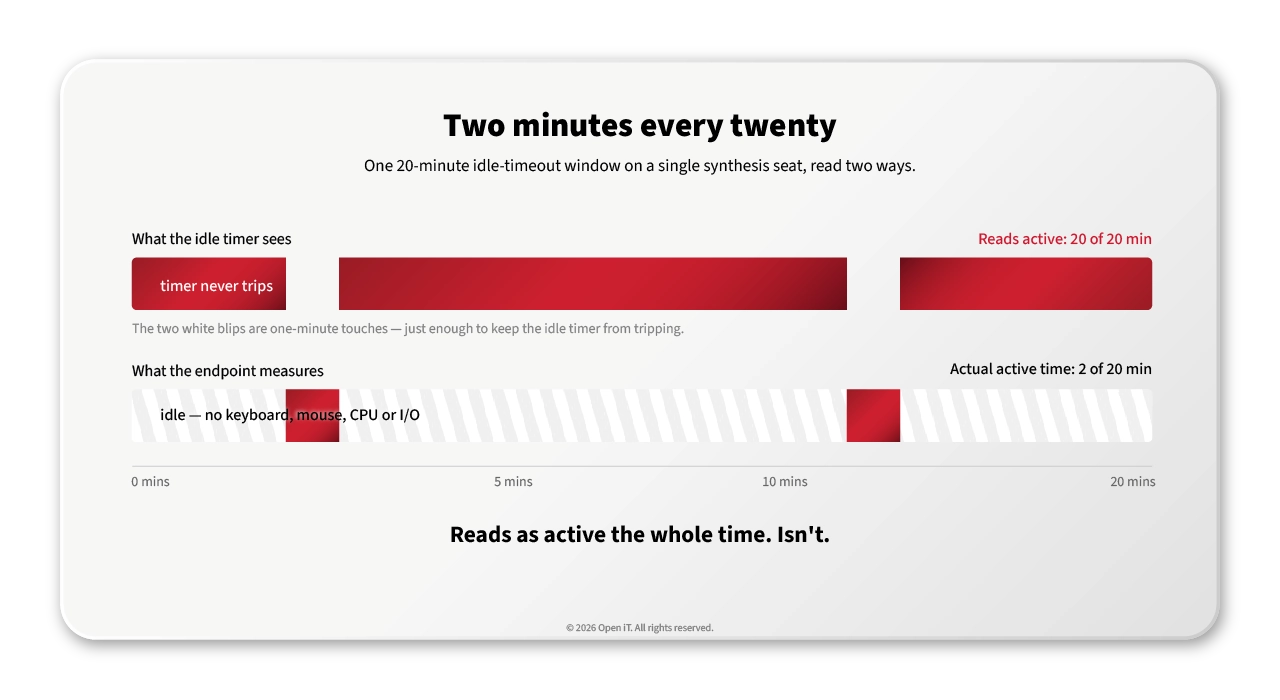
All of that is real capability, and it catches real waste – a seat nobody remembered to release, a denial pattern that justifies (or doesn’t) buying more capacity, a site quietly paying for licenses nobody there opens. None of it tells you whether a currently-claimed seat is actually being worked in – all of it still starts from the same checkout-and-idle-clock data. A synthesis seat that gets touched for two minutes every twenty, just often enough to reset the idle timer, reads as active the entire time no matter how many modules sit on top of that same log.
| What needs answering before renewal | The usual approach | Open iT (Level 1 + Level 2) |
|---|---|---|
| Is this seat currently claimed, and by whom? | Yes | Yes |
| Was someone turned away, and when? | Yes – denial tracking | Yes – Level 1 Denial Reports |
| Which site or business unit does this cost roll up to? | Yes | Yes |
| Has this seat sat idle long enough to release automatically? | Yes, against a fixed idle-timeout clock | Yes, correlated against measured inactivity rather than the clock alone |
| Is the person holding this seat actually working in it right now? | No – inferred from the checkout and the idle clock, not measured | Yes – keyboard, mouse, CPU, and I/O activity measured at the endpoint, via the Work Ratio Report |
| Did this year’s additions – approved one at a time, site by site – add up to something nobody reviewed before renewal? | No – each report is real-time or per-site, nothing rolls up to last year’s baseline | Yes – Open iT’s implementation team validates the drift number with the customer before the renewal, not per site in isolation |
That last row is the point of divergence. Real-time availability, denial tracking, cost allocation, and idle-timeout reclamation all answer questions about a single seat at a single moment. None of them – on their own – answer the question a renewal asks: does this year’s cumulative total, added a few seats at a time across every site, still match what the estate is genuinely using. That’s a different question from “is this seat idle right now,” and a tool built to answer the first one doesn’t answer the second.
Ninety days out from a renewal like this, the real question isn’t whether the platform has enough reports – it’s whether any of them answers the question that matters. A long menu of report categories doesn’t shortcut that work – it just moves the guessing from “do we have the data” to “which report has it.”
The fix is simple: measure how much of the checked-out time was actually spent working in the tool, per seat, per application — and go through those numbers with the customer before the renewal conversation, not after.
Even without touching individual machines, the basic checkout and denial data sitting in the license server logs already shows the shape of the problem: a pool that’s grown for several renewal cycles, denial patterns that do or don’t justify buying more, and sessions left open long after the work stopped. That’s a real, useful answer to “has this pool been reviewed as a whole” but it can’t settle one specific ambiguity: a seat touched for two minutes every twenty looks continuously active to a clock, and so does a seat that was opened once and never closed. Only measuring what’s actually happening on the machine tells those two apart.
That’s what direct activity measurement — keyboard, mouse, CPU, I/O — does: it shows whether a provisioned module was genuinely in use before the renewal, not after. That distinction matters most for exactly the modular product families this piece is about: Synopsys’s TestMAX splits into DFT, ATPG, Diagnosis, Manager, Advisor, and ALE, and Siemens EDA’s Calibre splits into nmDRC, nmLVS, PERC, Auto-Waivers, SONR, and Fab Insights – each a separate licensed product a team can provision for one project phase and never revisit. Design Compiler, TestMAX, IC Compiler, Calibre, MATLAB, and LabVIEW are tools this comparison already works for today.
The data only earns its keep once someone can act on it without waiting for a specialist to interpret the report.
Frequently Asked Questions
What is subscription drift in software license management?
Subscription drift is the gradual, unreviewed growth of a software entitlement pool: extra seats, licenses, or feature capacity added incrementally over time, with no single point where the running total gets checked against actual need.
How is subscription drift different from a one-time over-purchase?
A one-time over-purchase is a single decision that can be reviewed and reversed. Drift has no single decision to point to. It’s the sum of many individually reasonable additions that nobody added up until the renewal did.
How can entitlement drift be caught before the renewal?
By reviewing the total entitlement pool against actual, endpoint-measured usage on a regular cadence, not only at renewal, and by having one estate-wide view rather than a report per site or per license manager.
The next renewal is coming either way. The only real choice is whether it arrives with a number your team can explain, or one you’re both seeing for the first time.