



Organizations using Open iT for software license usage analytics often reach a natural next step: Power BI integration. Executive dashboards already live there. Financial reporting flows through it. Operational metrics are standardized within it.
The question isn’t whether Open iT data can be brought into Power BI—it can.
The real challenge is integrating license intelligence without duplicating the same definitions and rules inside your BI reports.
Many organizations start by exporting raw license data into Power BI and constructing utilization logic in DAX or Power Query. It works in the short term. Over time, however, it creates duplicated logic, inconsistent metrics, and governance risk.
License intelligence is not just another dataset. It is a computed, rule-driven model built on concurrency, entitlements, feature mapping, and temporal analysis. Recreating that logic in Power BI introduces structural problems that grow with scale.
The better approach is integration without duplication.
Why Software License Data Is Structurally Different
Traditional BI systems work with transactional data. ERP systems record purchases. HR systems track employee attributes. CRM systems log customer activity.
Software license environments operate differently. They are governed by license server rules and vendor-specific entitlement models. A single engineering tool may contain dozens of licensable features. Some are bundled. Some are token-based. Some are governed by configuration files or package definitions.
Usage is not simply “who opened an application.” It involves concurrent checkouts, feature-level consumption, denial events, idle behavior, and peak demand across time intervals.
License intelligence platforms like Open iT interpret this telemetry and derive meaningful metrics such as:
- Maximum concurrent usage
- Utilization ratios
- Feature-level demand
- Denial and refusal trends
- Historical usage patterns for forecasting
These metrics are computed results based on license server behavior. They are not flat log entries.
When raw license events are imported directly into Power BI, the BI layer often ends up reconstructing concurrency logic, feature relationships, and entitlement rules. That reconstruction often leads to inconsistencies.
WEBINAR: License data is not transactional data. Watch “From Data to Decisions” to see how Open iT transforms raw license telemetry into validated, decision-ready metrics. Here’s your invitation to watch the recording.

Open iT | Webinar On-Demand
From Data to Decisions: License Usage Analytics for Engineering Teams
The Hidden Risk of Rebuilding License Logic in Power BI
Duplicating license calculations inside Power BI may appear flexible. In reality, it introduces long-term architectural challenges.
First, definitions begin to drift. If peak usage is calculated differently in Power BI than in Open iT, reports eventually diverge. Leadership loses confidence when two dashboards show different answers to the same question.
Second, performance suffers. Engineering environments can generate significant telemetry across multiple license managers and distributed networks. Power BI typically performs best with curated datasets. Recomputing peaks and mappings can slow refresh and increase model maintenance.
Third, governance weakens. License optimization decisions directly impact renewal negotiations, budgeting, and audit defense. When entitlement interpretation and concurrency logic are duplicated in BI scripts, traceability becomes fragmented. In regulated or highly controlled environments, that is a measurable risk.
Finally, ownership becomes unclear. Who defines utilization thresholds? Who determines what counts as idle? Who classifies denials? When logic lives partly in a licensing platform and partly in BI formulas, accountability becomes blurred.
These are not cosmetic issues. They are structural.
CONNECT: Keep your BI clean and your license intelligence centralized.
The Sustainable Model: License Intelligence as a Governed Layer
A cleaner architecture separates responsibilities.
Open iT acts as the authoritative license intelligence layer. It collects and interprets license server telemetry, normalizes identity data, computes peak and utilization metrics, and preserves traceability. Power BI consumes validated, structured outputs and combines them with financial, organizational, and operational context.
In this model, Power BI becomes a visualization and analytics environment. It does not reinterpret licensing rules. The licensing engine remains centralized.
This separation ensures that every dashboard—whether operational or executive—references the same definitions of peak usage, utilization, and demand.
A Reference Integration Architecture
A well-structured integration typically follows this flow:
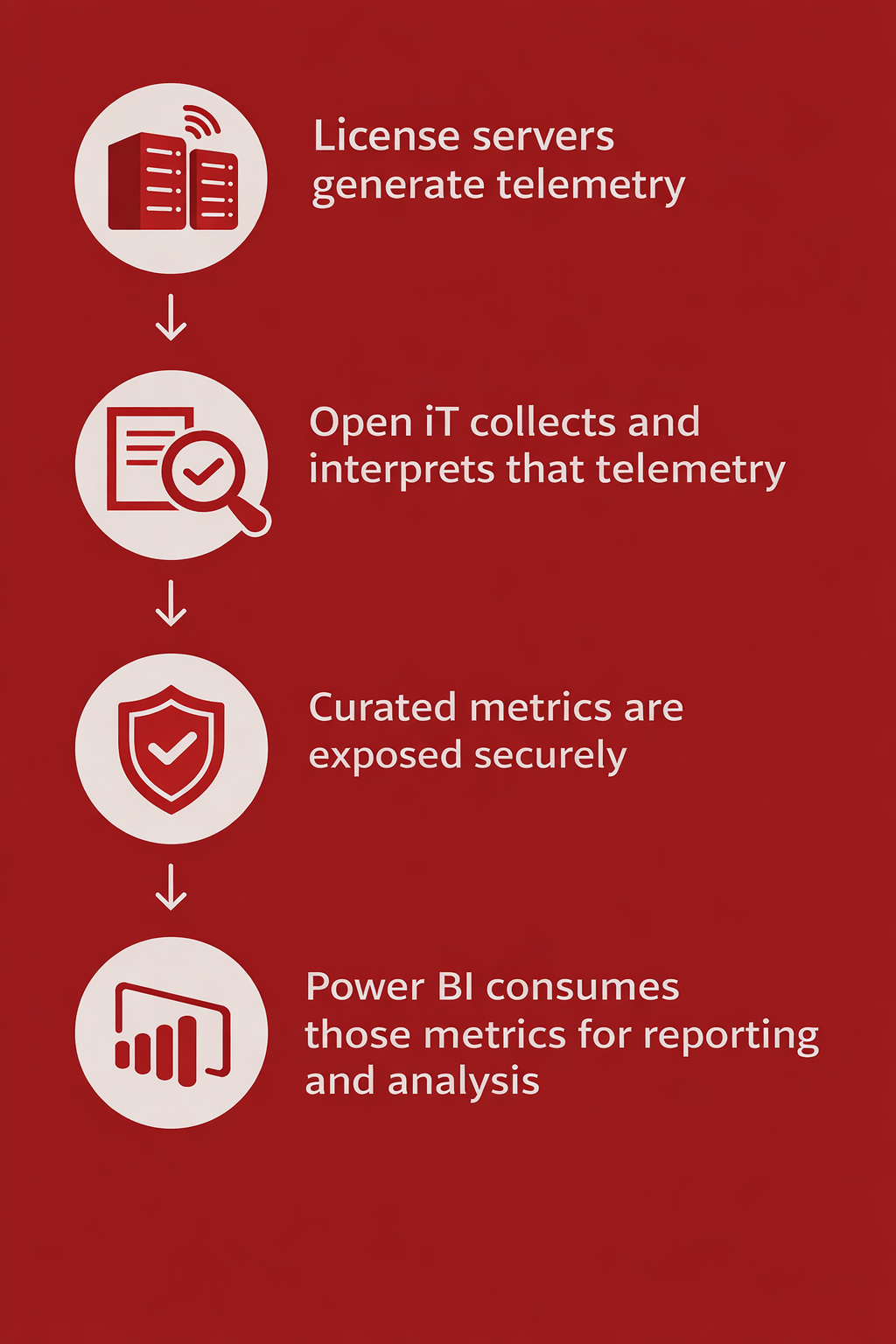
The key principle is that concurrency calculations, feature interpretation, and entitlement logic are computed once. Power BI references those computed values instead of recreating them in DAX.
This approach scales across multiple license managers, distributed subnets, and hybrid environments, including restricted or on-premises deployments.
What Meaningful License Intelligence Looks Like in Power BI
When integration is done correctly, Power BI dashboards focus on insight rather than rule reconstruction.
Executives can review utilization trends alongside contract values and departmental budgets. Engineering managers can evaluate feature-level demand without manually reconciling token structures. Finance teams can align license consumption with cost centers and renewal cycles.
Because the underlying metrics are centrally computed in Open iT, every dashboard reflects consistent definitions. There is no ambiguity about how peak usage was calculated or how denials were classified.
BI models remain clean and maintainable. They reference stable dimensions—such as user, feature, time period, and organization—rather than embedding vendor-specific entitlement logic.
The Strategic Advantage of Proper Integration
When Open iT serves as the centralized license intelligence layer and Power BI acts as the analytics front end, organizations gain a single source of truth.
Dashboards become defensible. Renewal negotiations are supported by traceable data. Audit exposure is reduced. BI development cycles accelerate because teams work with curated metrics rather than reconstructing complex licensing logic.
Most importantly, leadership can make confident decisions based on consistent, governed software license analytics.
Power BI is a powerful analytics platform. It should not become your licensing engine.
Contact Open iT to learn how to implement a secure, enterprise-ready Power BI integration that aligns license intelligence with your broader analytics strategy.
Talk to an Open iT expert.