

Mining
Every ounce you mine carries a software cost. Your license servers won’t tell you what it is.
Open iT puts your geology, mine planning and engineering software, from Leapfrog and Vulcan to Rocscience and FLAC3D, on one usage record. You renew on what got used, not on last year’s seat count.
- See exploration, planning and engineering software in one usage history
- Tell an open Leapfrog session from a geologist actually modeling
- Idle seats go back to the pool, and the model stays on the screen
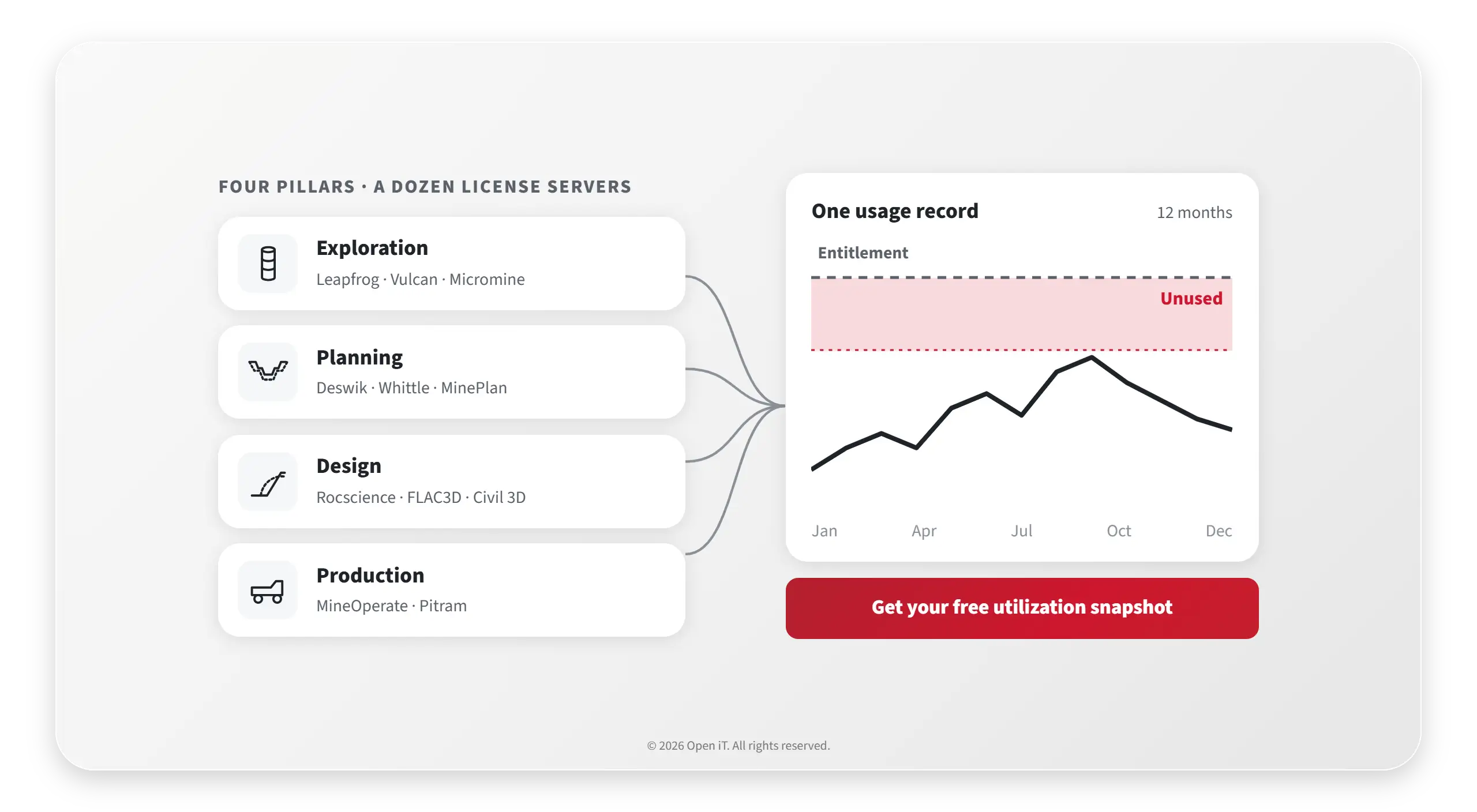
The software that defines your resource is a cost you renew blind.
For an explorer, the resource model is the share price. Geology software builds that model. For a producer, the same software, joined by pit optimization, scheduling, geotechnical and production systems, decides how much comes out each year and at what cost. In mining, software sits close to revenue.
Its use is another matter. Each vendor runs its own license server, and renewals follow last year’s seat count. When we spoke with a senior technology leader at one of the largest copper producers this year, we found no software usage tracking in place.
High metal prices pull mines into lower-grade ore that costs more per ounce to produce. When prices fall back, those ounces lose their margin first, and fixed costs decide which ones stay worth mining. Software is one of those fixed costs.
Open iT sees idle rates of 20 to 40 percent across engineering estates. Put a number on it: on a $10 million annual software line, every ten points of idle time is $1 million a year. That is cost per ounce you can take out without touching production.
What Open iT Does
1
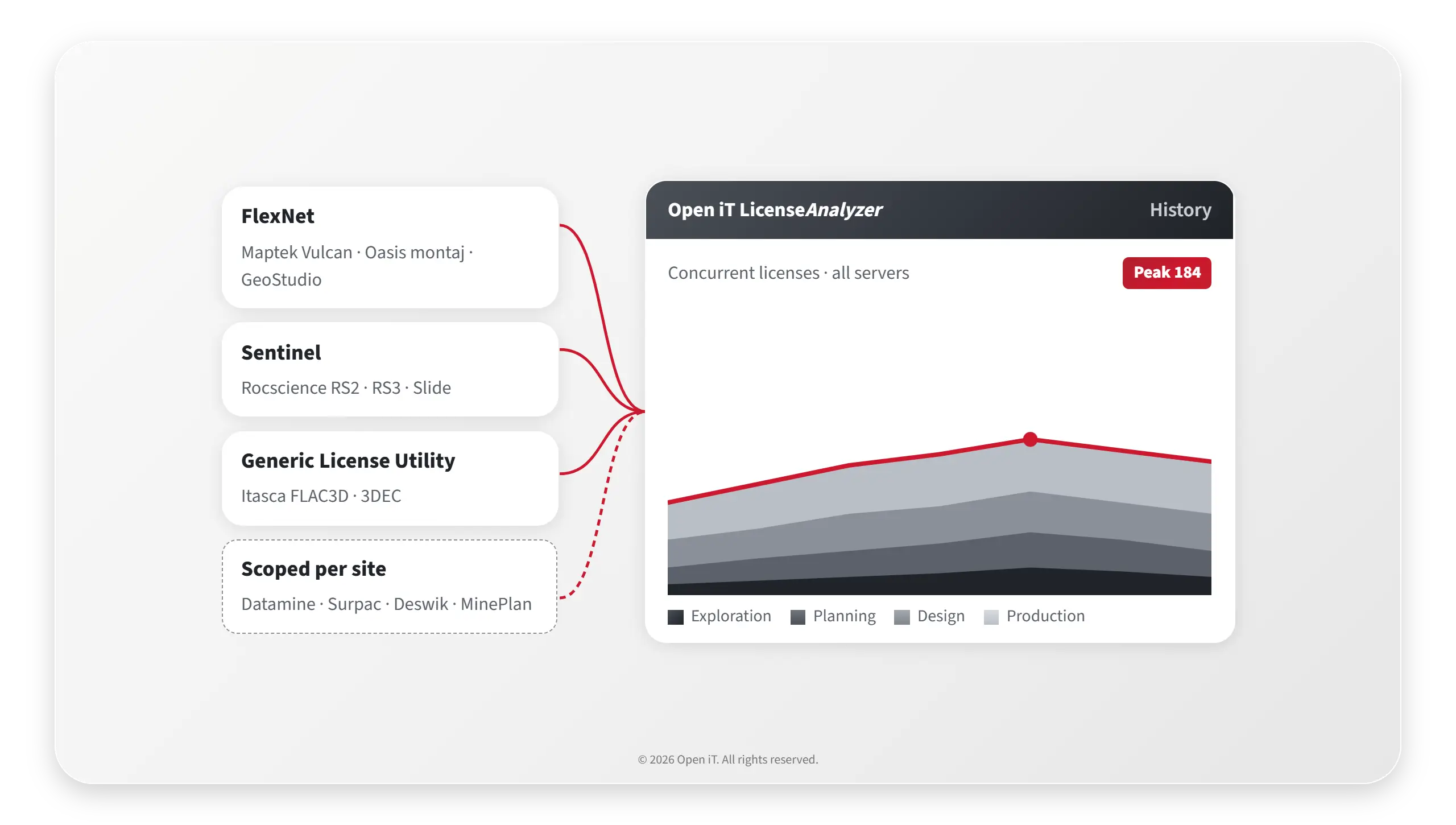
Put every mining application on one record.
LicenseAnalyzer™ meters more than 6,000 applications across 100 supported license manager configurations. Leapfrog, the Rocscience suite, FLAC3D, GeoStudio and Oasis montaj are on the supported list. Maptek Vulcan’s network license runs on FlexNet, which Open iT reads natively. Where a license manager sits outside the list, the Generic License Utility reads its command-line output.
2
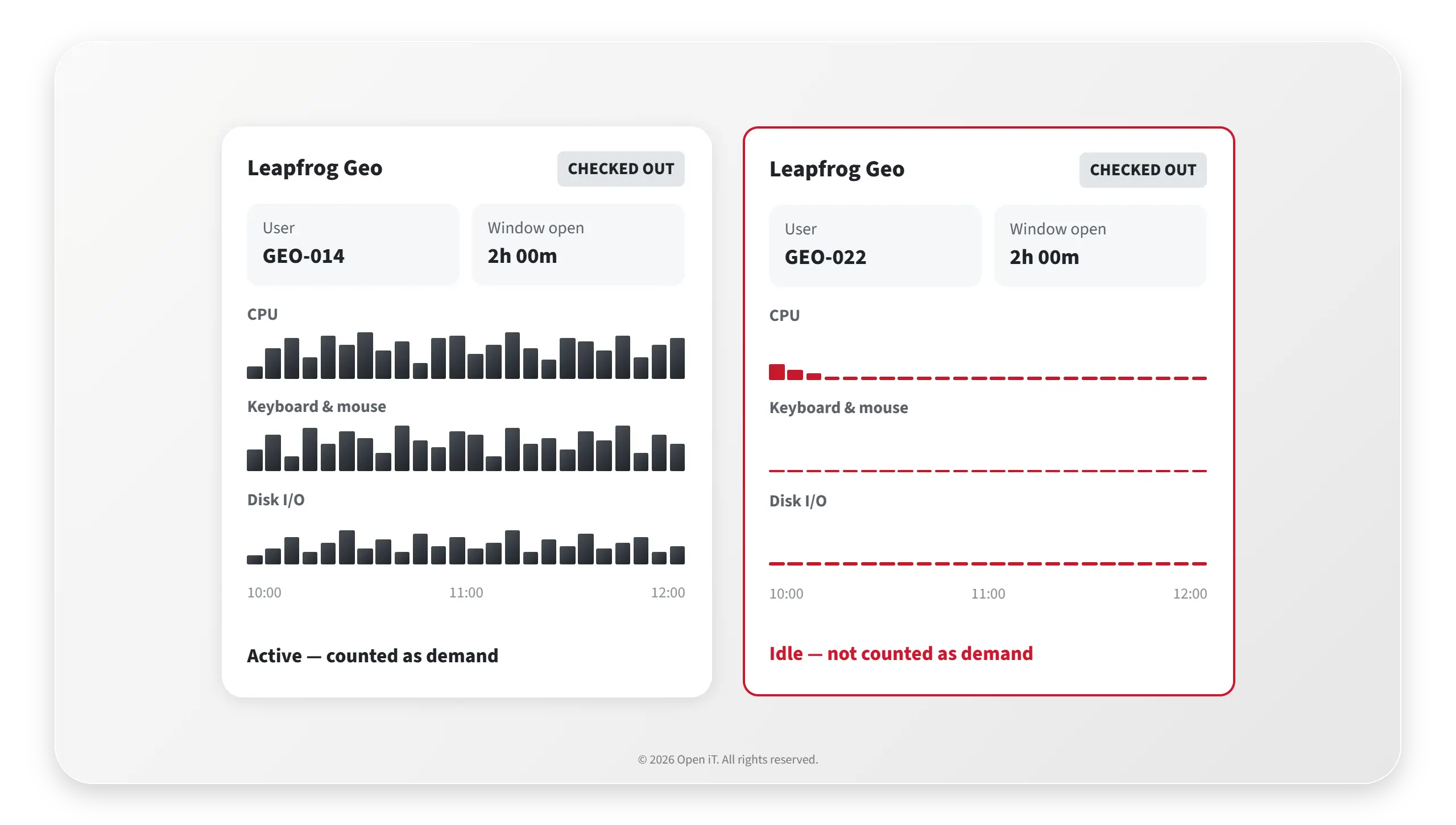
Tell an open session from a geologist working in it.
True Active Usage reads CPU, I/O, keystroke and mouse activity on the workstation. A Leapfrog window left open through a site meeting stops counting as demand. Usernames can be anonymized, reversibly or irreversibly.
3
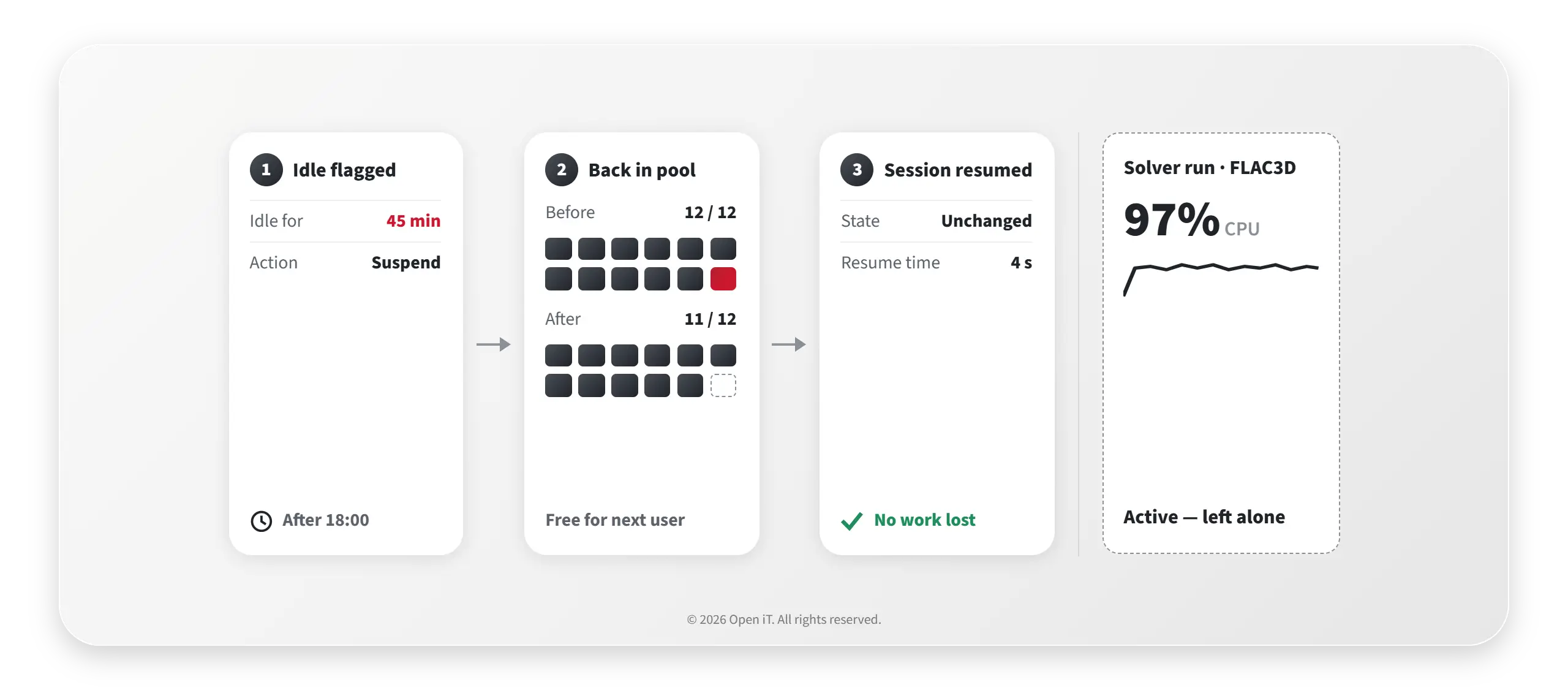
Reclaim idle seats without losing the work.
Open iT reclaims an idle license with one of four actions (log, standby, suspend or terminate) and applies time-of-day and day-of-week rules. Suspend returns the license to the pool and leaves the model on the screen. A solver run burning CPU counts as active work and is left alone.
4
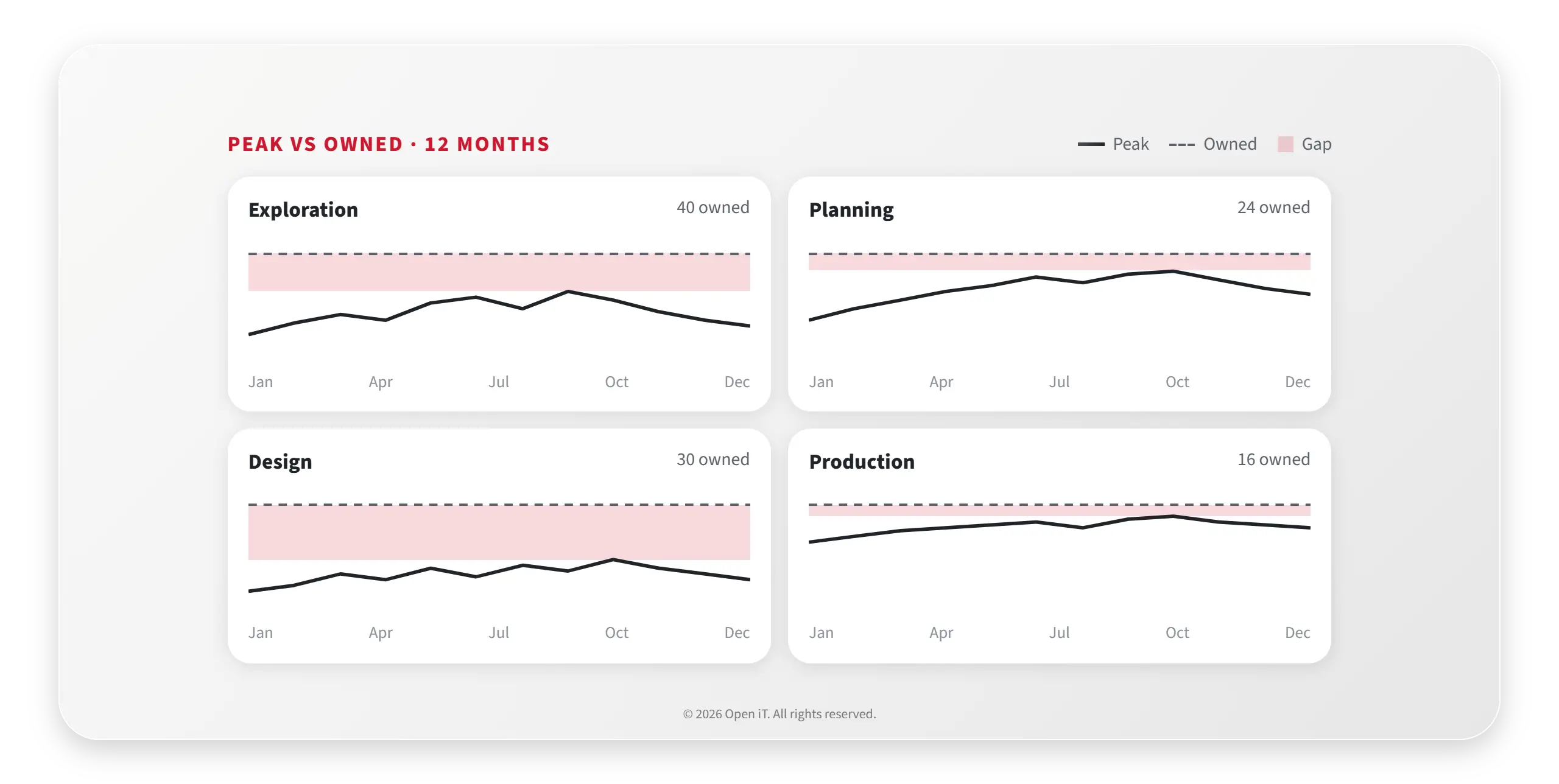
Renew pillar by pillar, on measured use.
Twelve months of concurrency per application and per module, metered on your own infrastructure, turns a renewal from a seat-count argument into an evidence one. Split it by exploration, planning, design and production, and each budget owner sees their own number.
Have questions? Talk to a licensing specialist.
Mining Software Savings Calculator
Enter what you spend on software in each part of the mine and see what recovering a share of it is worth, pillar by pillar. No email needed to see the result.
Leapfrog Geo, Datamine, GEOVIA Surpac, Maptek Vulcan, Micromine, Oasis montaj
Deswik, GEOVIA Whittle and MineSched, Hexagon MinePlan, Minemax
Rocscience, FLAC3D, 3DEC, GeoStudio, PTC Creo, AutoCAD, Civil 3D
Hexagon MineOperate, Pitram
Don’t know the split? Put your whole engineering software budget in the pillar it mostly serves.
20 percent is what Devon Energy took off its subsurface software budget, the nearest published result to a mining estate. Change it if you have your own figure.
Adds software cost per unit you produce. Use the unit you report in.
estimated recoverable each year
- Spend you keep
- Recoverable
- Total annual software spend
- $0
- Recoverable over three years
- $0
- Software cost per oz
- $0
- Recoverable per oz
- $0
How this is calculated
Every figure is arithmetic on your inputs. Nothing is modeled, weighted or benchmarked behind the scenes.
- Recoverable per pillar = pillar spend × recovery rate.
- Recoverable each year = the sum of the four pillars.
- Over three years = annual recoverable × 3. This assumes spend stays flat. Price rises at renewal would make it larger.
- Cost and saving per unit = spend ÷ production, and recoverable ÷ production.
- Default rate, 20% (editable, 5–40%): Devon Energy cut its subsurface software budget by 20 percent after putting 11 vendors and modules on one platform (Open iT customer success story, openit.com, 2022). It is an energy result, used here because energy and mining run similar geoscience software. It is not a promise for your estate.
What this cannot tell you
- How much of your software actually sits idle. That takes metering, and it is the number the whole result swings on. Open iT sees idle rates of 20 to 40 percent across engineering estates.
- Which applications can be reclaimed. Leapfrog, Rocscience, FLAC3D, GeoStudio and Oasis montaj are on Open iT’s supported list, and Maptek Vulcan runs on FlexNet. Datamine, Surpac, Deswik, MinePlan and Micromine are confirmed site by site.
- Where savings really fall. This applies one rate to every pillar. Real recovery differs by application and by how each one is licensed.
- Your peak demand. Twelve months of usage per application and module gives the peak against what you pay for, and that is the figure to take into a renewal.
Figures in USD. The default rate comes from one published customer outcome in energy and is not a projection for your operation.
Frequently Asked Questions
What is engineering and technical software asset management for mining?
It’s the practice of measuring how a mine’s specialist software gets used (geology, mine planning, geotechnical and design applications) and managing licenses against that measurement. A software inventory records what is installed. It doesn’t record who checked out a license, when, or for how long. Open iT reads the license servers and the workstations, then reports use per application, module and pillar.
Which mining applications can Open iT meter?
Leapfrog, Oasis montaj, the Rocscience suite, Itasca FLAC3D and 3DEC, GeoStudio, PTC Creo, AutoCAD and Civil 3D are on Open iT’s supported list. Maptek Vulcan’s network license runs on FlexNet, which Open iT reads. For Datamine, Surpac, Deswik, MinePlan and Micromine, the scoping call confirms the license manager and whether the Generic License Utility is needed. That is a configuration job, not a native integration.
We don’t track software usage today. Where do we start?
With what your license servers already record. The first stage reads every check-out: who used which application, when, for how long, how many people at once, and who was turned away. That alone shows your peak against what you pay for. Measuring real activity at the workstation and reclaiming idle seats come later, once the baseline exists.
Will reclaiming a seat interrupt a model or a scheduling run?
No. Only idle sessions are targeted. A solver or scheduling run using CPU counts as active work. Suspend hands the license back and keeps the session on the screen, and time-of-day rules keep a shift change or a planning deadline out of scope.
Is this monitoring individual geologists and engineers?
No. Workstation activity is measured to separate an idle session from an active one, and usernames can be anonymized, reversibly or irreversibly. Trend analysis that never names a person is the normal way to run it.
Your vendors know exactly what you contracted. Nobody on your side knows what you used, because the answer sits on a dozen license servers that don’t talk to each other. One record across exploration, planning, design and production closes that gap, and turns software from a fixed cost per ounce into one you manage.