


Federal CIOs are being asked to deliver more technology capability than ever before—AI adoption, zero-trust security, legacy modernization, cloud optimization, and data-driven decision-making—often without meaningful increases in funding.
At the same time, global IT spending is projected to exceed $6 trillion in 2026, according to Gartner. That figure dominates industry headlines and vendor conversations, but for federal IT leaders, it often feels disconnected from operational reality.
Most federal CIOs are planning against flat or marginal budget growth, often in the low single digits, with many agencies expecting no increase at all. This gap between macro-level IT investment growth and agency-level budgets is no longer temporary. It has become the operating baseline for federal IT leadership.
More Demand, Limited Funding
Much of the projected growth in global IT spending is driven by factors largely outside the federal appropriations environment. These include hyperscale investments, large-scale AI infrastructure expansion, and concentrated capital spending by commercial technology providers.
Federal agencies operate under a very different set of constraints:
- Flat or slowly growing appropriations
- Escalating subscription and licensing costs
- Expanding mandates for AI, cybersecurity, and modernization
- Increased oversight from OMB, GAO, and agency inspectors generals
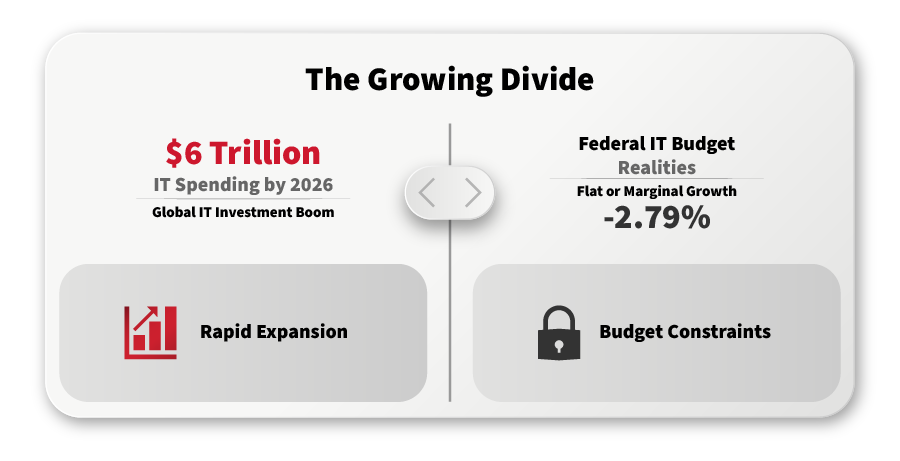
In this environment, new funding is an exception, not the rule. Modernization efforts are expected to be funded primarily by reallocating existing spending, not expanding it.
For CIOs, this means every dollar already in the IT portfolio matters. The challenge is no longer simply selecting the right technologies but finding the financial room to adopt them without disrupting mission operations.
Software: A Growing Cost Center with Limited Visibility
Software has quietly become one of the largest recurring cost drivers in federal IT portfolios—and one of the least transparent. Industry analysts project that global software spend will exceed $1.4 trillion this year.
Enterprise applications, engineering tools, analytics platforms, databases, and specialized technical software often account for a significant portion of IT spending. Yet many agencies struggle to answer basic questions about how these tools are used.
Common challenges include:
- Paying for licenses that are underused or never used
- Maintaining higher license tiers “just in case”
- Limited leverage during vendor negotiations due to lack of usage data
- Difficulty reallocating licenses across programs or bureaus
- Incomplete visibility into high-cost technical and engineering tools
These inefficiencies are rarely intentional. They accumulate over time as organizations grow; missions shift, and contracts renew under pressure.
When budgets are flat, however, the impact becomes unavoidable. Every unused or misaligned license represents funding that cannot be applied to higher-priority initiatives such as AI pilots, cybersecurity improvements, or system modernization.
Reframing Software Asset Management as a Strategic Capability
Historically, Software Asset Management has been associated primarily with compliance and audit response. In today’s fiscal environment, that framing is no longer sufficient.
Modern SAM—when supported by reliable usage intelligence—enables CIOs to:
- Distinguish actual demand from perceived demand
- Make evidence-based decisions during renewals and true-ups
- Reallocate existing assets before purchasing new ones
- Support accountability, oversight, and financial reporting requirements
In this context, SAM becomes a mechanism for financial agility, not simply a control function.
WEBINAR: Software asset management is no longer just about compliance. Watch “Software Asset Management’s Hidden Value” to see how usage intelligence supports cost control, audit readiness, and mission-focused decision-making. Here’s your invitation to watch the recording.

Open iT | Webinar On-Demand
Unlocking Hidden Value with Software Asset Management
Open iT: Helping Federal CIOs Do More
As a GSA contract holder, Open iT supports federal agencies in strengthening software asset management and IT financial management practices through usage-based intelligence aligned with federal procurement and governance frameworks.
Availability through GSA enables agencies to adopt software usage intelligence without lengthy procurement cycles, extended pricing reviews, or added justification overhead—an important consideration in environments where speed, compliance, and risk reduction matter as much as functionality.
Rather than focusing on expanding procurement, Open iT helps agencies extract greater value from the software they already own, supporting modernization goals within existing budget constraints.
DEMO: Turn flat budgets into funding flexibility.
Enterprise-Wide Usage Transparency
Open iT delivers granular, auditable insight into software consumption across the enterprise, including:
- Which users are actively using specific applications
- How frequently software is accessed
- Which features or modules are utilized
- Where licenses are idle or underutilized
This level of transparency enables CIOs to move from assumption-based planning to evidence-driven decision-making, a critical capability in federal budget formulation, audits, and oversight reviews.
Reclaiming and Reallocating Before Buying More
With accurate usage data, agencies can:
- Identify and reclaim unused or underutilized licenses
- Reallocate entitlements across programs or locations
- Align license tiers with actual operational needs
Many Open iT customers have identified double-digit percentage savings through license reclamation and entitlement of of right-sizing—freeing funds that can be redirected to higher-priority initiatives such as AI and cybersecurity.
Strengthening Vendor Negotiations
As software vendors continue to bundle offerings, increase subscription costs, and shift toward consumption-based pricing, objective usage data becomes increasingly important.
Open iT enables federal CIOs to approach negotiations with:
- Historical and current usage trends
- Peak versus average utilization metrics
- Defensible evidence to challenge over-licensing assumptions
This data-driven approach supports more balanced negotiation outcomes and helps reduce long-term vendor lock-in risk.
Supporting FinOps and IT Financial Management
As agencies extend FinOps principles beyond cloud cost management, software asset optimization has emerged as a natural next focus area.
Open iT supports broader IT financial management efforts by:
- Linking software usage directly to cost
- Supporting chargeback and showback models
- Enabling defensible budget justifications and audit responses
This integration strengthens CIOs’ ability to demonstrate stewardship and value in constrained fiscal environments.
Cost Control to Mission Enablement
In 2026, Software Asset Management is no longer just about compliance or audits—it is about mission readiness.
Federal CIOs who invest in usage intelligence gain:
- Greater financial agility in constrained budget cycles
- Increased credibility with oversight bodies
- The ability to fund innovation without sacrificing stability
The $6 trillion IT spending headline may dominate industry conversations. For federal agencies, measurable insight, operational efficiency, and disciplined control are what ultimately enable meaningful progress.
If flat budgets are your reality, visibility must be your advantage.
Talk to Open iT about gaining the usage intelligence needed to optimize software spend and redirect savings toward AI, cybersecurity, and mission-critical initiatives.
Schedule a consultation with Open iT.