






Major Commodities Company Seamlessly Manages a Critical Software Conversion through Detailed Usage Reports
"With the help of Open iT specialists, we have set up license management rules for the most critical applications and now we are adding more to the list based on business input."
Technical Computing Analyst, Major Commodities Company
Highlights
- A major commodities company needed to cut down IT costs without disrupting the work of their geoscience and engineering communities.
- Tracking the software usage of each user and the automated harvesting of inactive licenses generated real cost savings.
- One software product alone reaped an estimated cost savings of $639, 000 on pay-per-use licenses.
- Open iT usage reports were used to encourage buy-in from stakeholders and support a critical software conversion.
Business Challenge
In 2006, when the company first purchased Open iT, the IT team was mostly concerned with ensuring key users of technical applications had access to the software they need. Users were being denied access during peak times in the business lifecycle and asking for additional licenses but there was little information on how many were available and who was using them.
When Open iT LicenseAnalyzer Level 1 alone was in place, the Technical Computing support team used it to document whether new licenses were actually needed and to negotiate licensing agreements that fit the business need. When the company sought greater cost savings in 2015, one area of focus was to reduce the cost of software assets. Not only senior management and the IT department cared about managing cost – the user community was also motivated to look for cost savings if it would not impact the result of their work.
Managing a Critical Software Conversion with Open iT Data
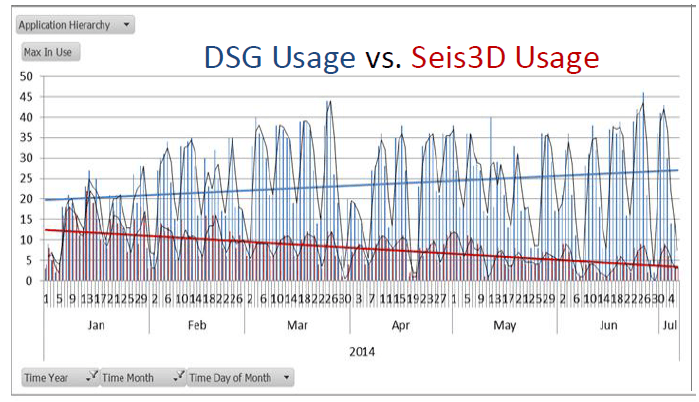
The science team was interested in switching software products from the same vendor. This required engagement from the users to gain buy-in, lead the change and assist in the significant work to redesign workflows, train users on the new tool and monitor uptake.
Open iT usage reports provided the data to identify who the power users in each region are. These individuals then helped with evaluation and conversion while Open iT monitored the uptake of the new software alongside the decline in use of the old one.
Whitepapers
Cost Allocation and IT Chargeback
The most efficient way to create more accountability and awareness of how IT resources are used is to implement a chargeback system.
Software Usage Monitoring and Optimization
Learn how usage monitoring in an E&P IT environment can be beneficial for many stakeholders.
Rising Use of Subscription and Pay-per-Use Software Licensing Models
Have a meaningful software usage metrics and tools to evaluate and plan appropriately prior to making new licensing decisions.
Take a Guided Tour
Get answers with a one-on-one walk-through.
Schedule a live demo today. We’ll show you how your business can benefit from an efficient software asset management program with Open iT usage metering tools.
Latest Blogs

FinOps & Software License Costs: Showback and Chargeback as Behavioral Control Systems
In engineering environments—software development, R&D, HPC, and hybrid IT platforms—showback and chargeback are often treated as accounting exercises. The goal is typically framed as fairness: allocating costs accurately so that each team pays its share. Yet this framing misses the more

Rising AEC Tech Spend Makes Software Asset Management Non-Negotiable
The architecture, engineering, and construction (AEC) industry is experiencing rapid digital transformation, and software asset management (SAM) is emerging as a critical practice to maximize the value of technology investments. Firms are not just increasing technology spending—they are deploying transformative digital tools, including BIM,

ArcGIS Pro Migration: Sustaining Success After ArcGIS Desktop Retirement
As Esri approaches the ArcGIS Desktop retirement on March 1, 2026, ArcGIS Pro migration has become a defining initiative for GIS teams worldwide. Many organizations began planning years ago, often immediately after Esri announced the retirement timeline. Yet completing the technical transition away from
Subscribe to our newsletter
Sign up to receive the latest news and updates.